Sunday Seven – Persian New Year

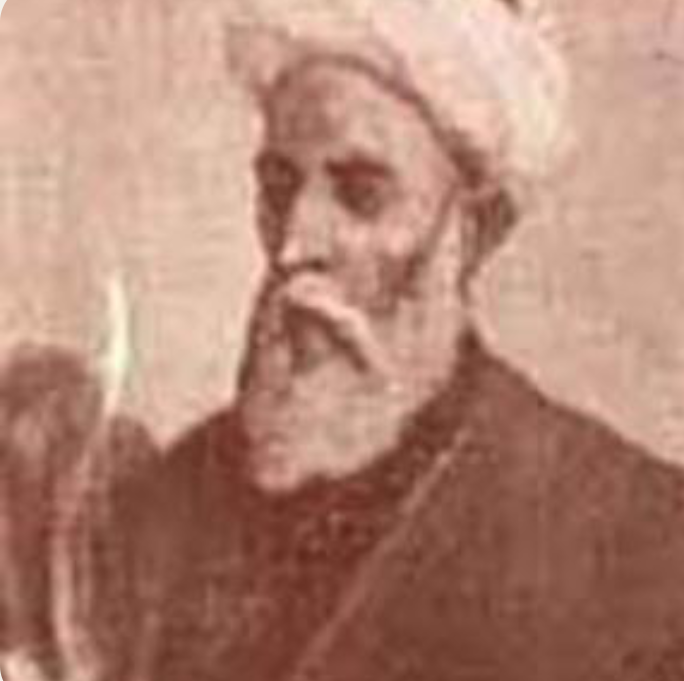
I was supposed to go to a Persian friend’s New Year part but that was cancelled. The Persian New Year or Nowruz is on March 20th.  Every year Nowruz coincides with the arrival of spring – it is a celebration of the links between humans and nature.  In honor of the Persian New Year I decided to do quotes by Persian poets for this week’s Sunday Seven.

Whatever is produced in haste, goes hastily to waste. Saadi Shirazi (1210 – 1291).

Have patience, all things are difficult before they become easy. Saadi Shirazi.

Be melting snow. Wash yourself of yourself. Rumi (1207 – 1273).

Stop acting so small. You are the universe in ecstatic motion. Rumi.

Raise you words, not voice. It is rain that grows flowers, not thunder. Rumi.

Live life as if everything is rigged in your favor. Rumi.

I died a lot to love a little with you. Yaghma Golrrouee

Your heart and my heart are very, very old friends. Hafiz (1315 -1390)

Ever since happiness heard your name, it has been running through the streets trying to find you. Hafiz.

It does not matter where I am. The sky is always mine. Sohrab Sepehri (1928 – 1980).

Some literary humor for an otherwise dull day

This letter is a parody written by Nick Farriella in the style of Fitzgerald – something he might have written as he quarantined in the South of France during the Spanish flu of 1918. We recently read The Great Gatsby and I’m amazed at how wonderfully Mr. Farriella has captured Fitzgerald’s spirit in this piece of writing.

Dearest Rosemary,

It was a limpid dreary day, hung as in a basket from a single dull star. I thank you for your letter.

Outside I perceive what may be a collection of fallen leaves tussling against a trash can. It rings like jazz to my ears. The streets are that empty. It seems as though the bulk of the city has retreated to their quarters, rightfully so. At this time, it seems very poignant to avoid all public spaces. Even the bars, as I told Hemingway, but to that he punched me in the stomach, to which I asked if he had washed his hands. He hadn’t. He is much the denier, that one. Why, he considers the virus to be just influenza. I’m curious of his sources.

The officials have alerted us to ensure we have a month’s worth of necessities. Zelda and I are stocked up on red wine, whiskey, rum, vermouth, absinthe, white wine, sherry gin, and lord, if we need it, brandy. Please pray for us.

You should see the square, oh it is terrible. I weep for the damned eventualities the future brings. The long afternoons rolling forward on the ever-slick bottomless highball. Z says it’s no excuse to drink, but I just can’t seem to steady my hand. In the distance, from my brooding perch, the shoreline is cloaked in a dull haze where I can discern an unremitting penance that has been heading this way for a long, long while. And yet, amongst the cracked cloudline of an evening’s cast, I focus on a single strain of light, calling me forth to believe in a better morrow.

Faithfully yours,

F. Scott Fitzgerald

How absolutely brilliant!! I hope you enjoyed reading it as much as I did.

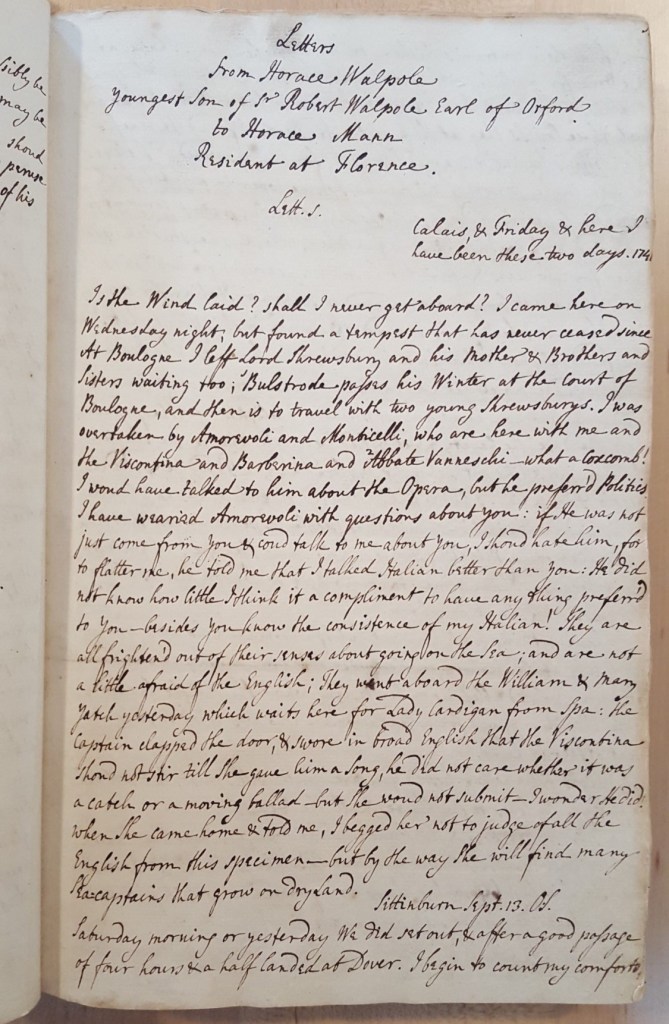
Horace to Horace: Serendipity.

Letter published by Yale University Press.

On January 28, 1754, Horace Walpole, the 4th Earl of Orford and a voracious letter writer, wrote a letter to Horace Mann, in which he coined the word serendipity. Horace Mann (1706 – 1786) was a British diplomat who lived in Florence and kept an open house for the English gentry that traveled to Florence. Walpole met Mann in 1739 during one on his trips to Florence, and the two started a correspondence which lasted over 40 years. It was in one of these letters that Walpole coined the word.

The letter itself not only explains why he used the word, but why he thought it was a most appropriate word to be used. Walpole had made a discovery of a connection between two old European families by finding a link between their coats of arms. Walpole continues in his letter:

“This discovery I made by a talisman, which Mr. Chute calls the Sortes Walpoliance, by which I find everything I want, a pointe nommee, whenever I dip for it. This discovery, indeed, is almost of that kind which I call Serendipity, a very expressive word, which, as I have nothing better to tell you, I shall endeavor to explain to you: you will understand it better by the derivation than the definition. I once read a silly fairy tale, called “The Three Princes of Serendip” ;  as their Highnesses travelled, they were always making discoveries, by accidents and sagacity, of things which they were not in quest of: for instance, one of them discovered the a mule blind of the right eye had travelled the same road lately, because the grass was eaten only on the left side, where it was worse than on the right – now do you understand Serendipity? One of the most remarkable instances of this accidental sagacity, (for you must observe than no discovery of a thing you are looking for comes under this description,) was of my Lord Shaftsbury, who, happening to dine at Lord Chancellor Clarendon’s, found out the marriage of the Duke of York and Mrs. Hyde by the respect with which her mother treater her at table…”

Horace Walple letter to Horace Mann, January 28, 1754
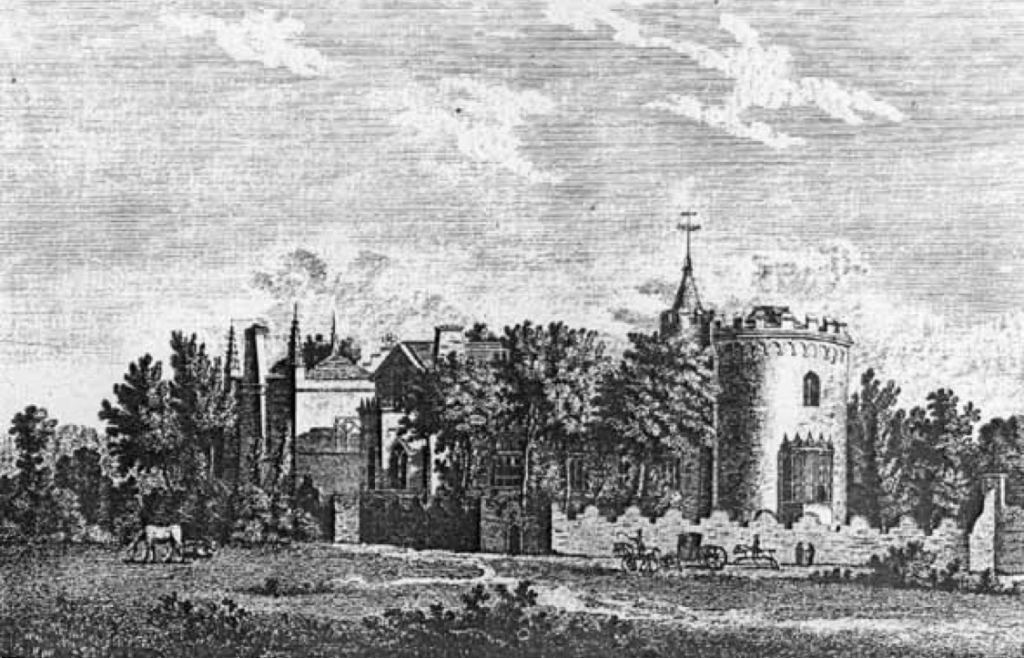
Horace Walpole’s Gothic Style Strawberry Hill House

Along with coining serendipity, Horace Walpole was an author, a politician, and is known for reviving the Gothic style of both writing (The Castle of Otranto, 1764) and architecture (in his home Strawberry Hill near London). Yale University Press published all his letters in 48 volumes.

Serendipity – From Persian Poets to the Earl

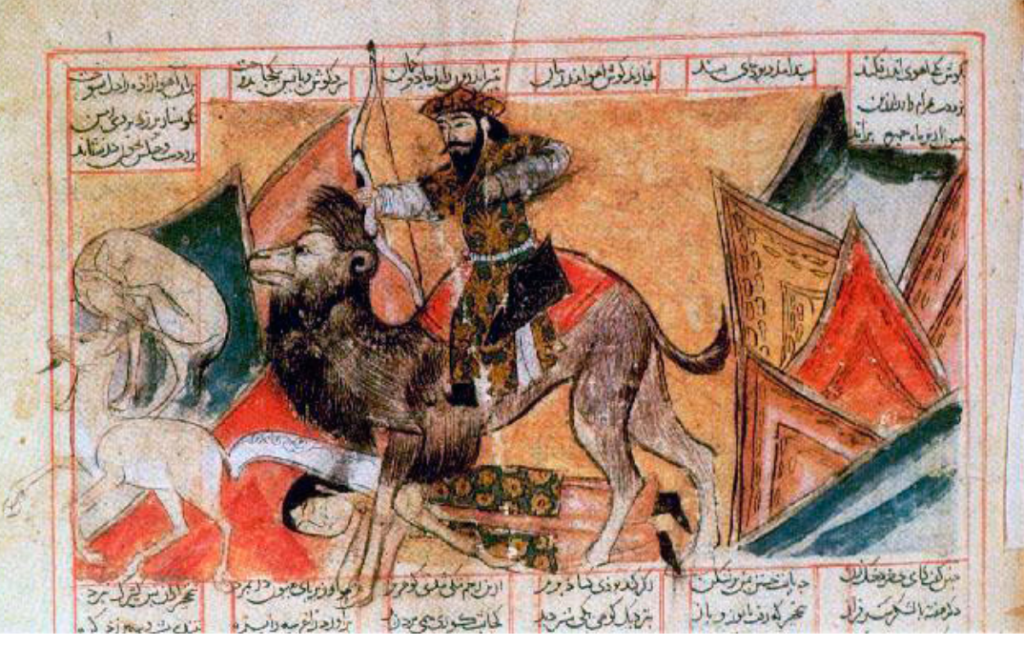
From 420 – 438 CE, there ruled a Sasanian king by the name of Bahram Gor (406 – 438 CE) in Persia. He was a benevolent ruler whose reign was mostly peaceful. He is however mostly remembered for being the favorite protagonist of Persian poets.

Emperor Bahram Gor – a favorite of poets

The first poet to write about Bahram was Ferdowsi (940 – 1020), who made him the central figure in Ferdowsi’s epic masterpiece Shahnameh (Book of Kings) written between 977 and 101 CE.

Then in 1197, Bahram was the main protagonist in Nizami Ganjavi’s (1141 – 1209) romantic poem Haft Paykar (Seven Beauties), which was based on the Shahnameh. This was followed in 1302 by the poem Hasht-Bihisht (Eight Paradises) which was written by Amir Khosrow (1253 – 1325), and was based on Haft Paykar. Hasht-Bihisht is also framed around folktales and legends of Bahram Gor. However, in this poem Khosrow added the story of the Three Princes of Serendip.

The Italian Translation

An Armenian, known as M. Christoforo Armeno, who was born in Tabriz, Iran in the 16th Century, and was fluent in both Persian and Italian translated the story of the Three Princes of Serendip from Khusrow’s Hasht-Bihisht into Italian. He told the story verbally to a Venetian printer named Tramezzino  who published the story in a small volume of Oriental Tales under the name of Peregrinnagio di tre figluoli del re di Serendippo in 1557.

With this translation, the legends and folklore associated with Bahram Gor finally entered Europe, gained a great deal of popularity, and were translated into German and French. Chevalier de Mailly’s French translation was further translated into English in 1722, and published under the title, The Travels and Adventures of Three Princes of Serendip.

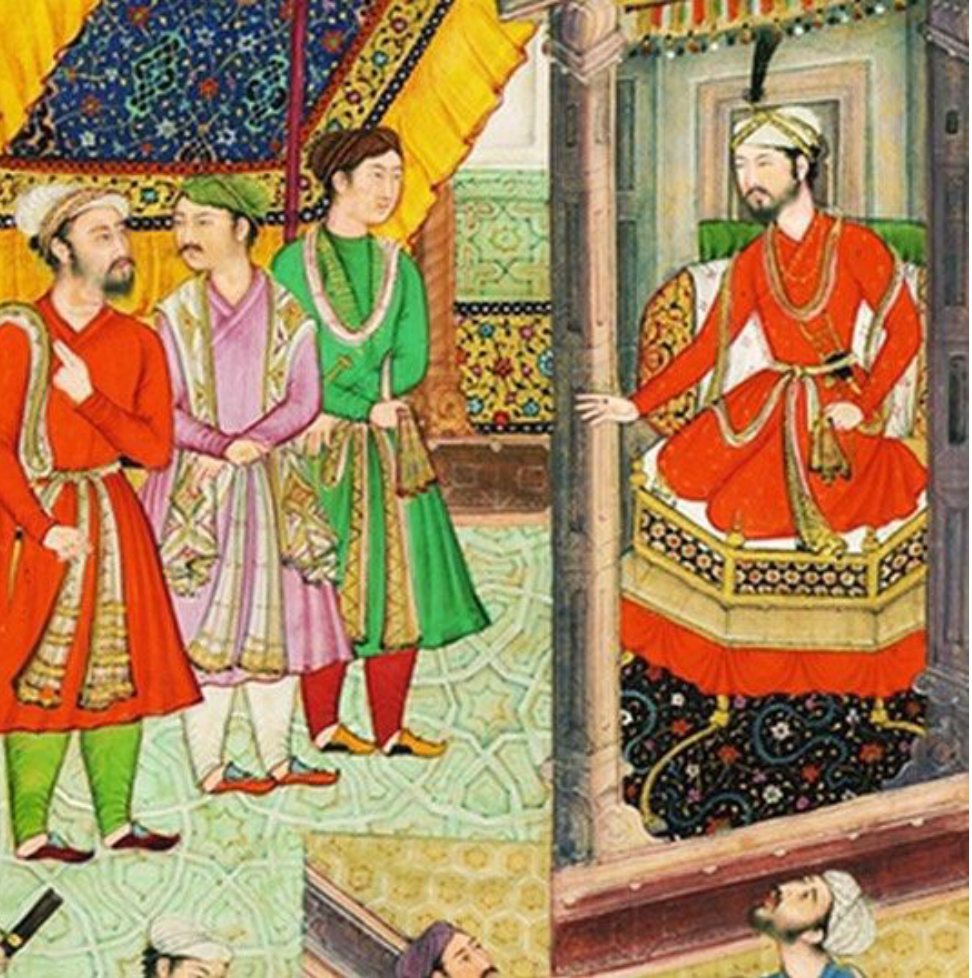
Henry Walpole, 4th Earl of Orford

It was this translation that Henry Walpole (1717–97), son of British Prime Minister Robert Walpole and the 4th Earl of Orford read as a child and remembered long after as an adult when he coined the word “serendipity’ in a letter he wrote to his friend Horace Mann on January 28, 1754.

Sunday Seven

During Christmas break, I visited Amsterdam, and the Anne Frank House.  So much has been written about Anne Frank, that I wouldn’t know what to add.  In one of the display cases, there were Anne’s journals, and a note saying that Anne’s father had told her to write down the beautiful, meaningful sentences or quotes she came across while reading.  That registered with me – I too come across beautiful sentences and quotes, and I think every Sunday I will list a minimum of seven that I have come across during the week. 

So here is my first list of seven.

Discontent is a good thing: discontented people can modify and improve their worlds, leave them better. Leave them different (Neil Gaiman: Why our future depends on libraries, reading, and daydreaming).

There are tales that are older than most countries, tales that have long outlasted the cultures and the buildings in which they were first told (Neil Gaiman: Why our future depends on libraries, reading, and daydreaming).

I took half a packet of smokes to Geel Piet, who thought all his Christmases had come at once (Bryce Courtenay: The Power of One).

Mankind at its most desperate is often at its best (Bob Geldof).

How wonderful it is that nobody need wait a single moment before starting to improve the world (Anne Frank).

Wie boter op zijn hoofd heft, moet uit de zon blijven (He who has butter on his head should stay out of the sun) (Dutch proverb).

I didn’t always have things, but I had people – I always had people (Ta-Nehisi Coates, Between the World and Me).

No one is useless in this world, who lightens the burdens of another (Charles Dickens).

Percontation Point

Earlier this week I learned about another wonderful punctuation mark that seems to have fallen out of use – or I should say never really caught on – Percontation point or the Rhetorical Question mark. It might be used most appropriately in – are you crazy – where clearly the speaker is not expecting a response.

The backward question mark.

In the late 16th century, English printer Henry Denham was concerned that the unsavvy readers of English may not catch on to the fact that the question did not require a response and proposed the use of a backward question mark to indicate a rhetorical question. It didn’t really catch on and it fell out of use completely by the 17th century.

I can see it being quite useful on Twitter where one often doesn’t know whether a response is required or not. It also has found use in art work and tshirts.

Magritte, Kierkegaard, & de Saussure

If you name me, you negate me. By giving me a name, a label, you negate all the other things I could possibly be.” Danish Philosopher Soren Kierkegaard (1813 – 1855).

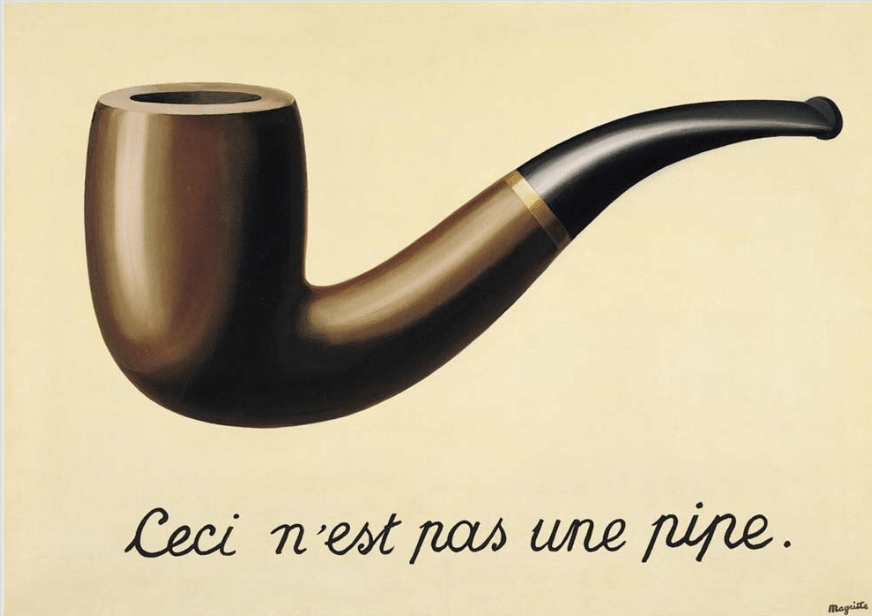
Rene Magritte (1898–1967) was a Belgian surrealist artist who is known for challenging the viewers’ preconditioned perceptions of reality.One could wax and wane endlessly about the philosophical underpinnings of his pipe painting, Treachery of Images (1929). Or the way I understand it – Magritte was saying two things here – this is not a pipe since you can’t really stuff some tobacco into it and smoke it as you would a pipe. The second is that it’s not a pipe because it’s an image of a pipe. And really the word pipe can be changed at any time to say for instance pig – in which case – this would still no longer be a pipe. So the word and the image are simply representations of the real thing, and not the real thing.

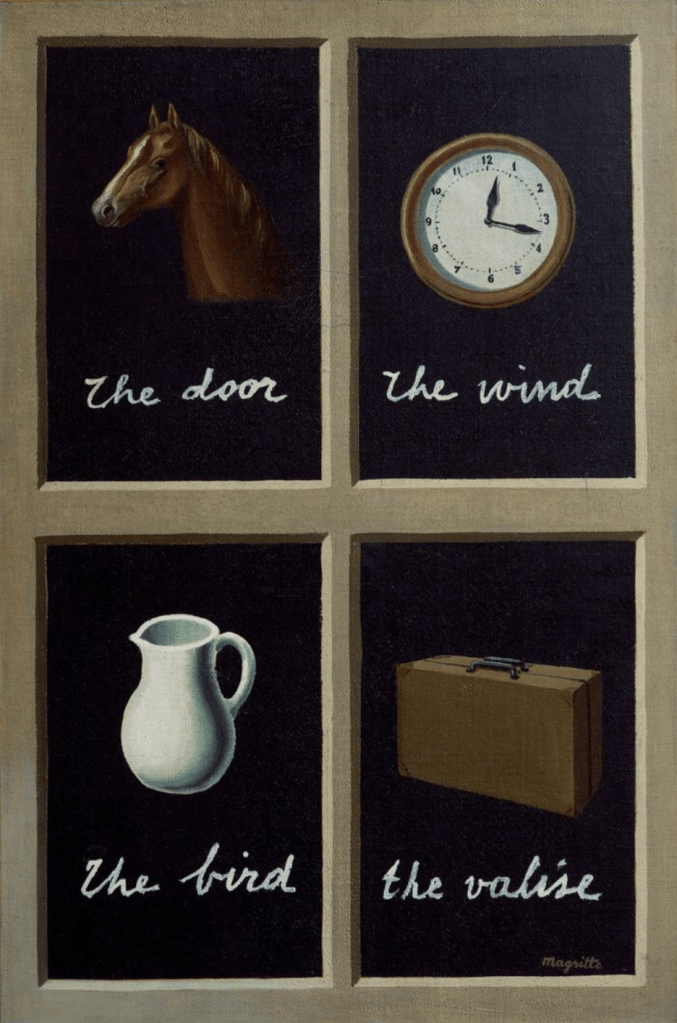
The Interpretation of Dreams 1935

Words and images are human representations of the real live tangible thing which we can touch and experience. They have names because we gave them these names – there is always a disconnect between the real thing and the way we see and name something – perhaps that’s why the images are also painted through a window.

Key to Dreams 1927 …the sky, the bird, the table, the sponge

The paintings are depictions of the challenges put forth by the influential Swiss linguist Ferdinand de Saussure (1857-1913) who clearly saw that the relationship between a thing and its name are totally arbitrary. The word gets its meaning from existing within a context of the system of naming that exists and has existed for centuries. Magritte challenged this same arbitrary relation in these paintings.

The Key To Dreams, 1930 …. the acacia flower, the moon, the snow, the roof, the storm, the desert

So Magritte, Kierkegaard, & de Saussure come together to help us understand and challenege, and find new ways of looking at old things.

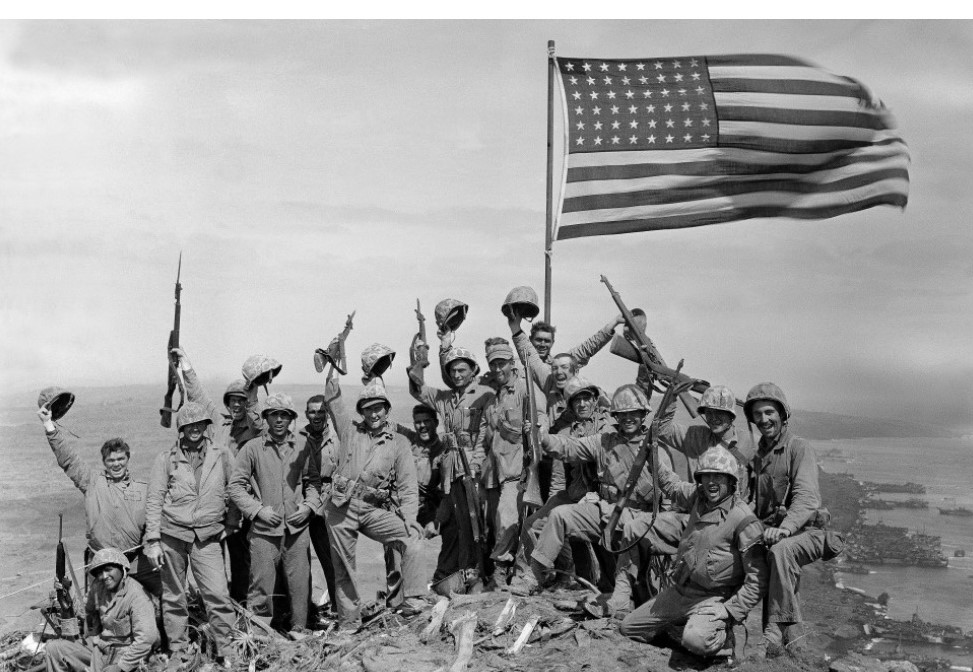
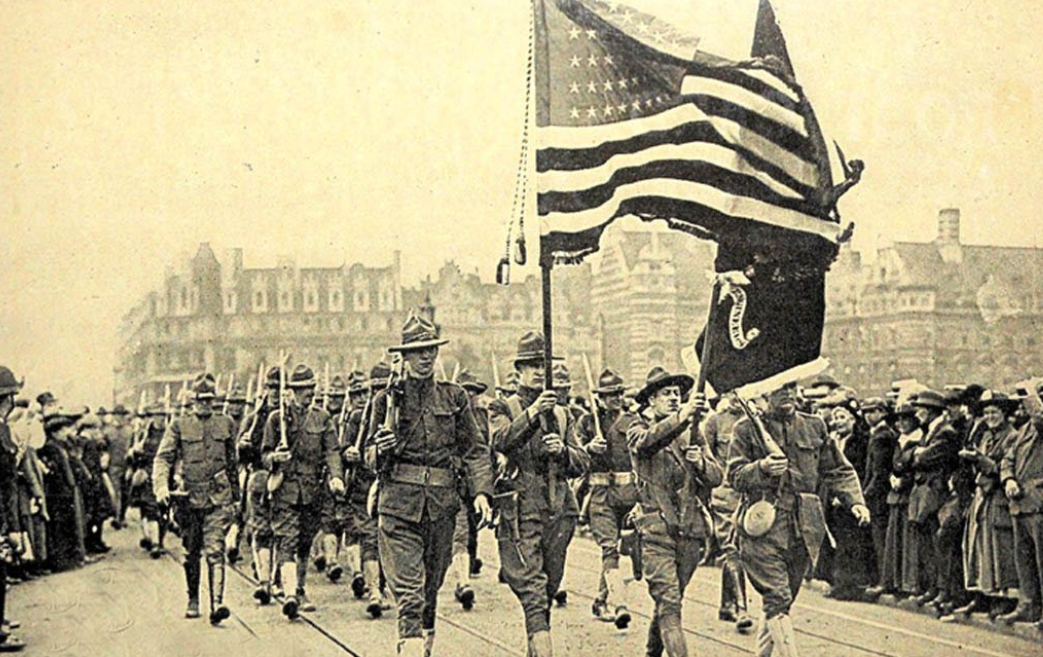
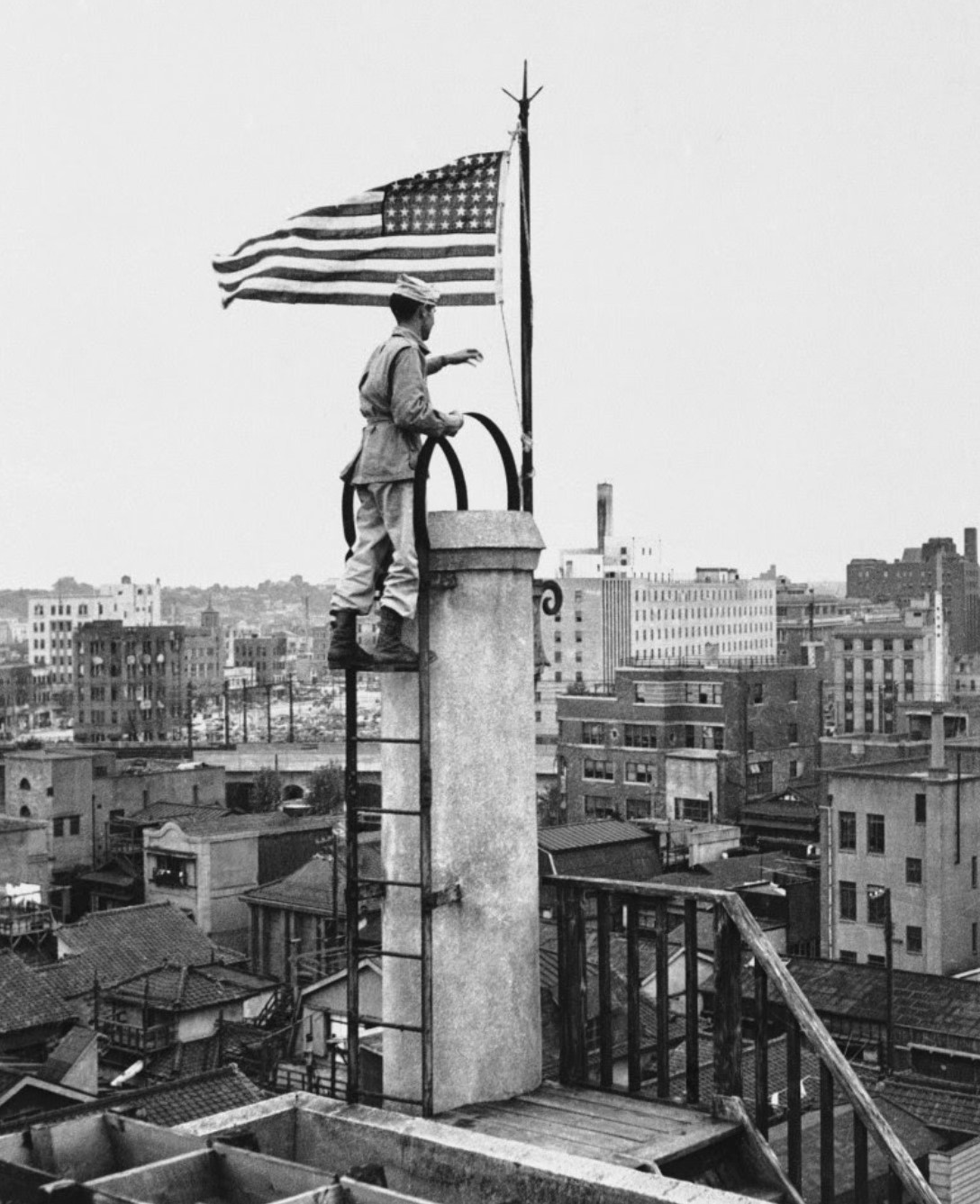
Ragged Old Flag

On this Flag Day, I wanted to honor the flag with this poem by Johnny Cash.

Ragged Old Flag

I walked through a county courthouse square
On a park bench an old man was sitting there
I said, your old courthouse is kinda run down
He said, naw, it'll do for our little town
I said, your old flagpole has leaned a little bit
And that's a ragged old flag you got hanging on it

He said, have a seat, and I sat down
Is this the first time you've been to our little town?
I said, I think it is
He said, I don't like to brag
But we're kinda proud of that ragged old flag

You see, we got a little hole in that flag there when 
Washington took it across the Delaware
And it got powder-burned the night Francis Scott Key
Sat watching it writing say can you see
And it got a bad rip in New Orleans
With Packingham and Jackson tuggin' at its seams

And it almost fell at the Alamo
Beside the texas flag, but she waved on though
She got cut with a sword at Chancellorsville
And she got cut again at Shiloh Hill
There was Robert E. Lee, Beauregard, and Bragg
And the south wind blew hard on that ragged old flag

On Flanders field in World War one
She got a big hole from a Bertha gun
She turned blood red in World War Two
She hung limp and low a time or two
She was in Korea and Vietnam
She went where she was sent by Uncle Sam

She waved from our ships upon the Briny foam
And now they've about quit waving her back here at home
In her own good land here she's been abused 
She's been burned, dishonored, denied, and refused

And the government for which she stands
Is scandalized throughout the land
And she's getting threadbare and wearing thin
But she's in good shape for the shape she's in
'Cause she's been through the fire before
And I believe she can take a whole lot more

So we raise her up every morning
We take her down every night
We don't let her touch the ground and we fold her up right
On second thought, I do like to brag
'Cause I'm mighty proud of that ragged old flag

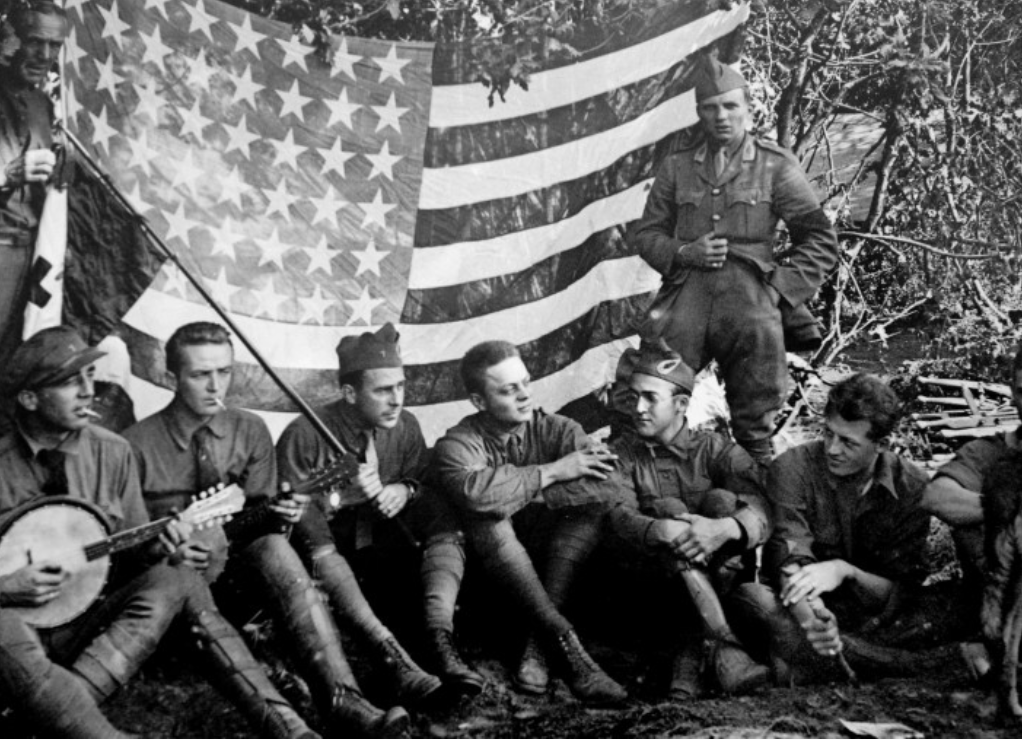
(Images Courtesy Smithsonian.com, US Govt and War Archives Websites)

Bildungsroman

Now this is an interesting word.  I was wondering about its origin because it clearly does not sound like an English word. Like many other untranslatable words this one is also German – bildung literally means education and learning, and roman means a novel – and the word has come to mean a novel that focuses on the growth of the protagonist or simply a coming-of-age book.

The word was coined by German philologist Johann Karl Simon Morgenstern (1770 – 1852) in the 1820s during the period of German Enlightenment. He first used the word when he was lecturing students at the University of Dorpat on the self-actualization that individuals realize as they navigate the journey from childhood to young adulthood. The book he may have been lecturing on was Johann Volfgang von Goethe’s novel Wilhelm Meister’s Apprenticeship (1795), which now is considered the first novel of theis genre.

The first Bildungsroman: Goethe’s 1795 Novel

During the period of Enlightenment, the centuries old feudal system ended, and there was a burgeoning middle-class.  Artists and authors moved away from religious and aristocratic patronage and gravitated towards this middle class. This was a different, revolutionary era – individuals looked to themselves for their salvation, and personal journeys became of great importance. As a result, authors started writing narratives about personal, mainly spiritual, growth which eventually we now know as Bildungsroman.

When most of us think of American Bildungsroman literature, Mark Twain’s Huck Finn and Adventures of Tom Sawyer immediately come to mind. Another example is J. D. Salinger’s The Catcher in the Rye.

Within the genre, there are subgenres –Erziehungsroman is the academic growth of the protagonist, Kunstlerroman is the realization of an artist’s potential, and Zeitroman is one in which the both the era and the protagonist develop together.  So there we have it – an in-depth look at a literary term we have all used when writing papers on Huck Finn!!

A Labor Day Tribute

The Statue of Liberty Soliloquy 
BY Jim Johnson 

Give me your poor, your mouth breathing, your drooling
Give me your tired masses.
I have floors to clean, tables to set, guests to feed.
Give me preferably your Scandinavians.
I have shoes to shine. So hurry up now, give me your Blacks.
I have laundry. Give me a few Orientals.
I have flowers, lawns to trim, fruit trees. How about some Latinos.
I have boats to unload. Give me some Irish then.
I have minerals to mine. Give me any from the
slag heaps of Europe.
I have this thin soil to till. So send me some serfs.
I have trees to cut. Finns will do.
Just give me your workers, your farmers. Give me your all.
I exclude no one ? not even democrats. Socialists,
communists, intellectuals excepted.
I have so much work to do.

This tribute to both immigrants and labor was written by 2008 Duluth Poet Laureate Jim Johnson.