Before it was divided into East and West, Berlin had a large underground train system that covered the entire city. Like everything else, this too was divided by the wall and some train lines ended up exclusively in the East or the West, while some ended up in both – so a train could start in West Berlin, cut through a section below East Belin, and then be under West Berlin again.
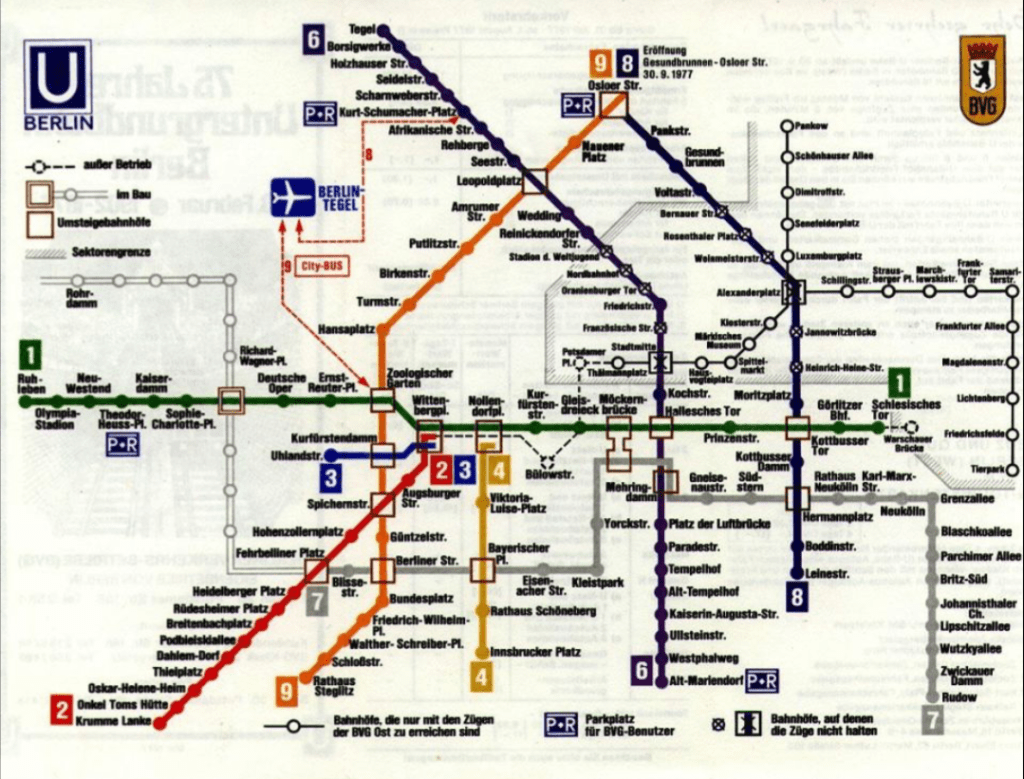
West Berlin subway map from 1979
The thin lines show train lines only in the East, while the stations marked with an X show stations in East Berlin where the West Berlin train did not stop.
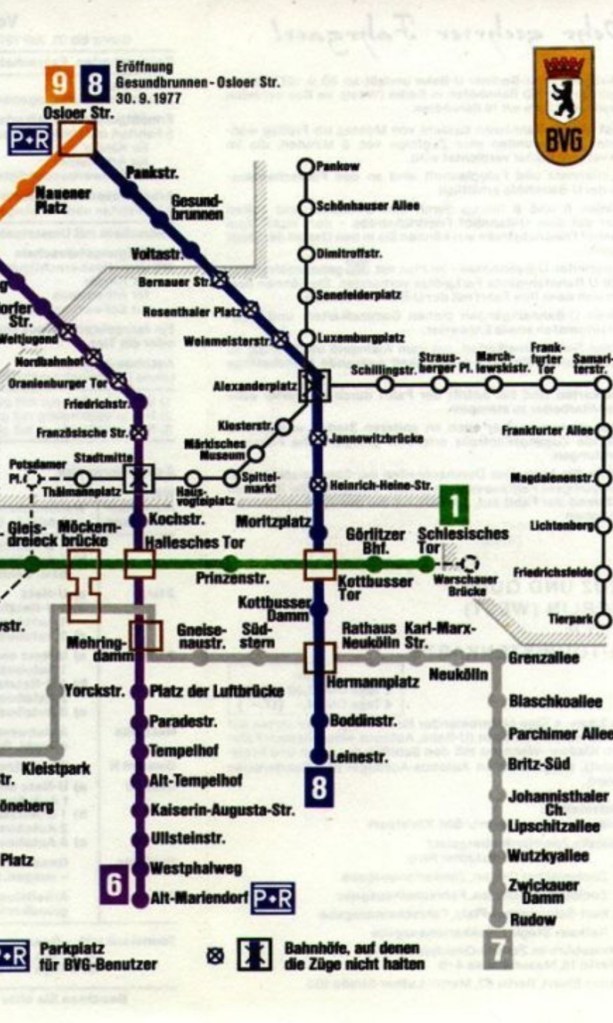
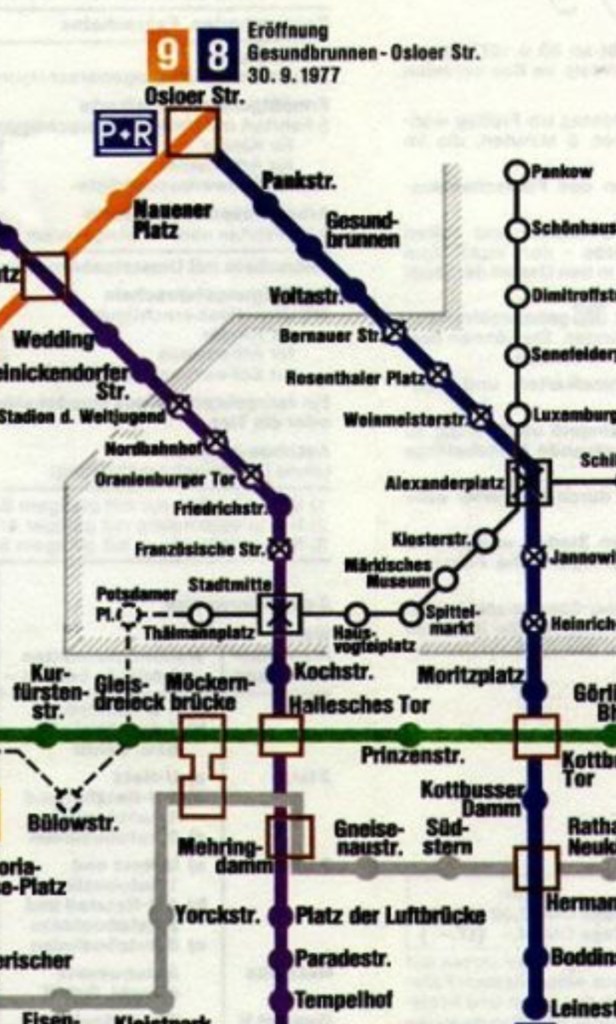
East Berlin Subway Map with all West Berlin stations removed.
The trains thst started in West Berlin were not allowed to stop at the stations in the East, they would slow down and roll through the eerily empty station and then speed up again. Often these stations were patrolled by East German Guards. Interestingly, the trains were allowed to operate in this manner, and not completely stopped, because the trains were owned by and were a good source of revenue for the East German regime. These stations were marked on West Berlin’s subway maps simply as “Banhofe, auf denen die Zuge nicht halten” – the train does not stop at this station.
The stations came to be known as Ghost Stations – they were dimly lit and completely empty, and saw no human activity for decades. After the wall fell, these stations appeared to be frozen in time with 30 year old posters still hanging on the walls.
One of the stations Friedrichstrasse was completely in East Berlin but was used by West Berliners to change trains and go from one patform to the next. It was used as a border crossing and this was also where the West Berliners who came to meet relatives in the East came in and left from – as a result the station withnessed many tears and heartbreaks.
All evidence of the past has been removed after reunification, and it is difficult to imagine that the bustling stations of today are the same ghost stations of yesterday.
(Source: YouTube Video, Atlas Obscura, and berlin.de).
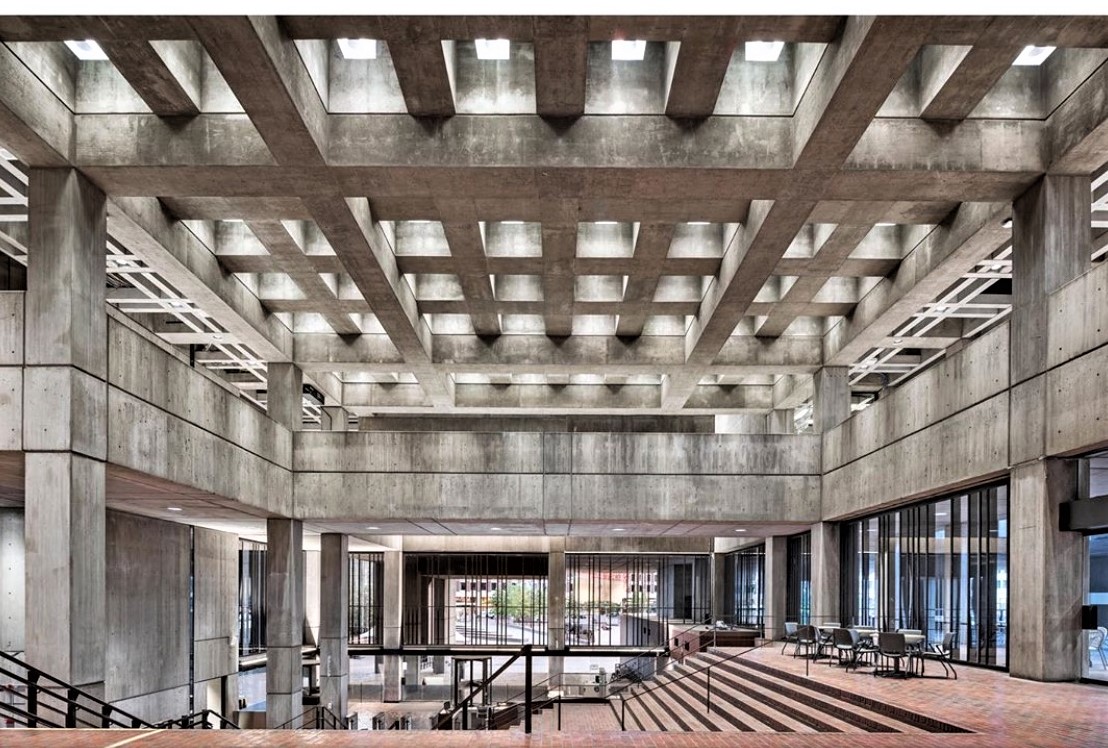
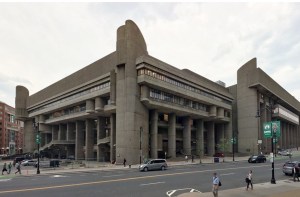
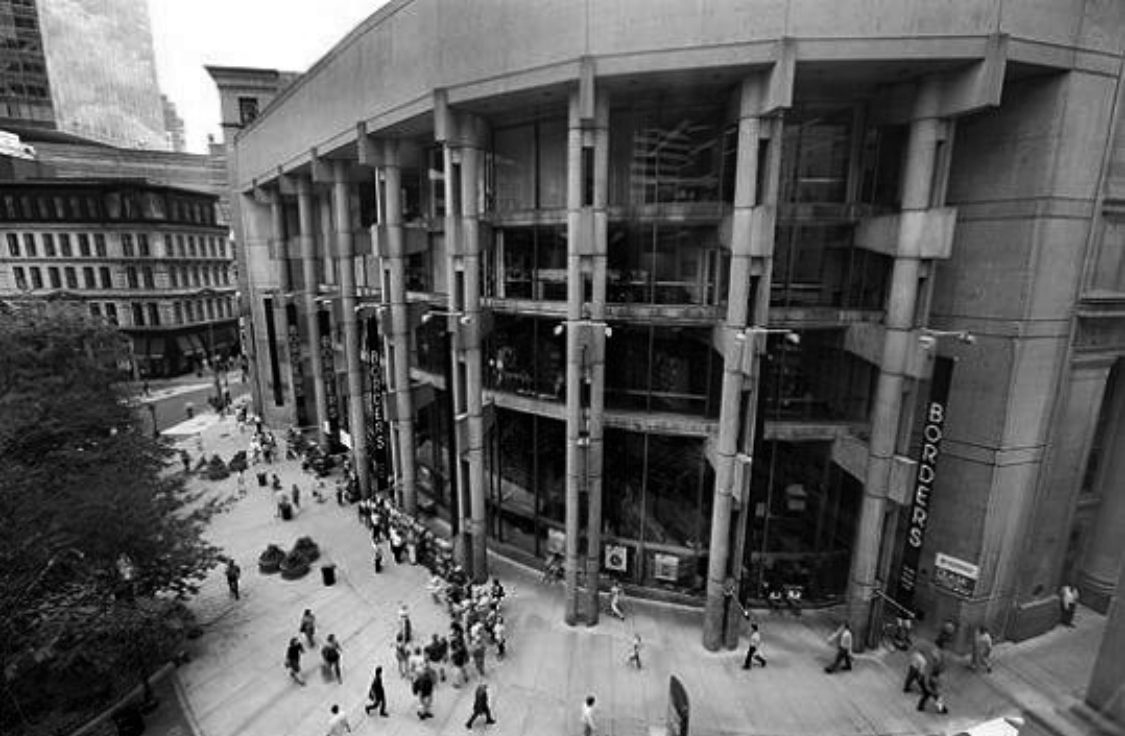
If one can tear themselves away from the cobblestoned beauty of Quincy market, from the culinary delights of Faneuil Hall, and from the narrow streets of the Italian North End that is practically bursting at its seams with history, and head towards Government center and City Hall in what was known as Scollay Square, one will come face to face with these gargantuan, yet lyrical, concrete giants of brutalism.
The post-World War II era put Boston on a path to reinvigorate itself and tear off the shackles of narrow cobblestones streets and old brownstone buildings. Brutalism architecture with its honest, concrete, progressive look seemed to fit the bill.
Boston’s Government Center Buildings
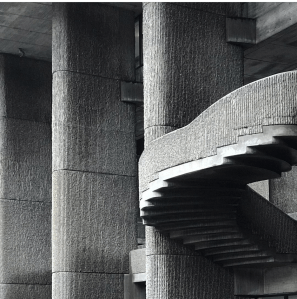
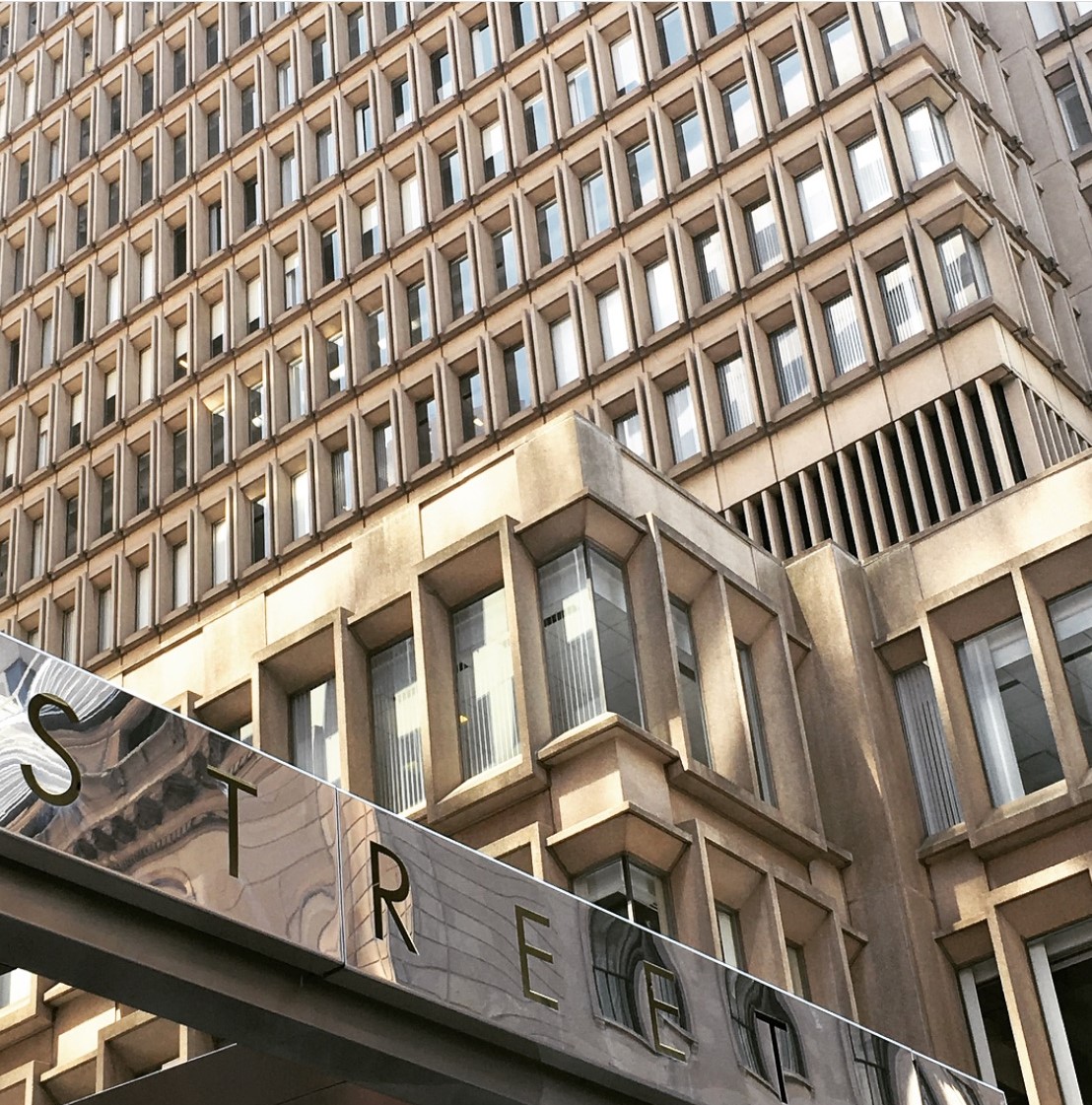
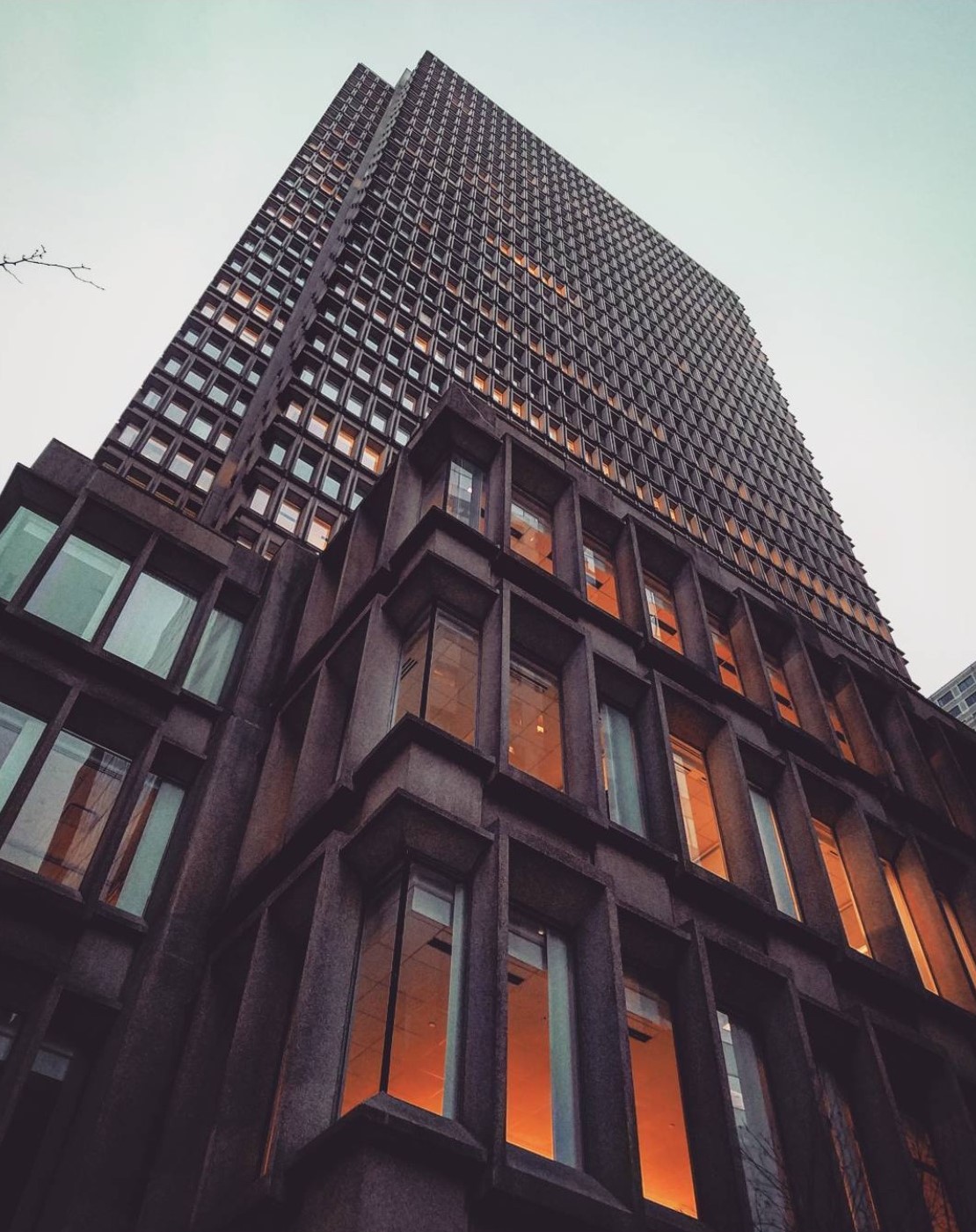
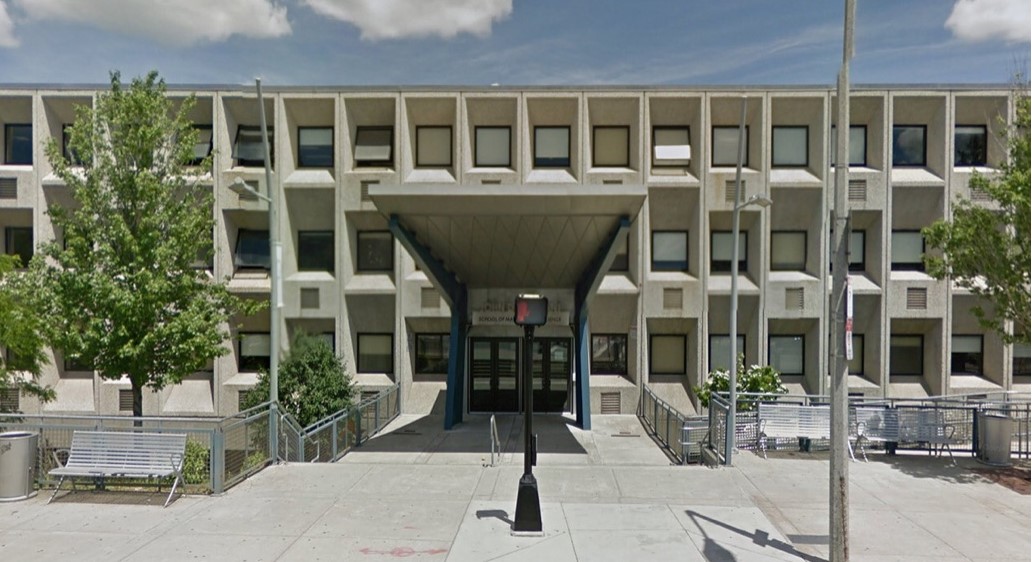
Brutalism is a sub-genre of modernist architecture that lasted from 1950s to mid-70s. It is so called not because of the “brutish” appearance of the building but is taken from the French term for raw concrete, “beton brut.” It was mostly used for government buildings, schools, and public housing built after World War II. Brutalism is characterized by the blocky appearance of buildings that most often have a recurring geometric design and are built with massive amounts of poured concrete.
Boston City Hall and the Government Center buildings stand a stone’s throw from the Quincy market – but centuries separate these two sites architecturally. Other buildings followed -including the State Street Bank, Boston Five Cents Savings Bank, the Harbor Towers and the MIT Hermann Building. Today Boston boasts the largest concentration of brutalist architecture in the US.
Government Center Building
(All imges courtesy of Boston Magazine and Architectural Digest websites).
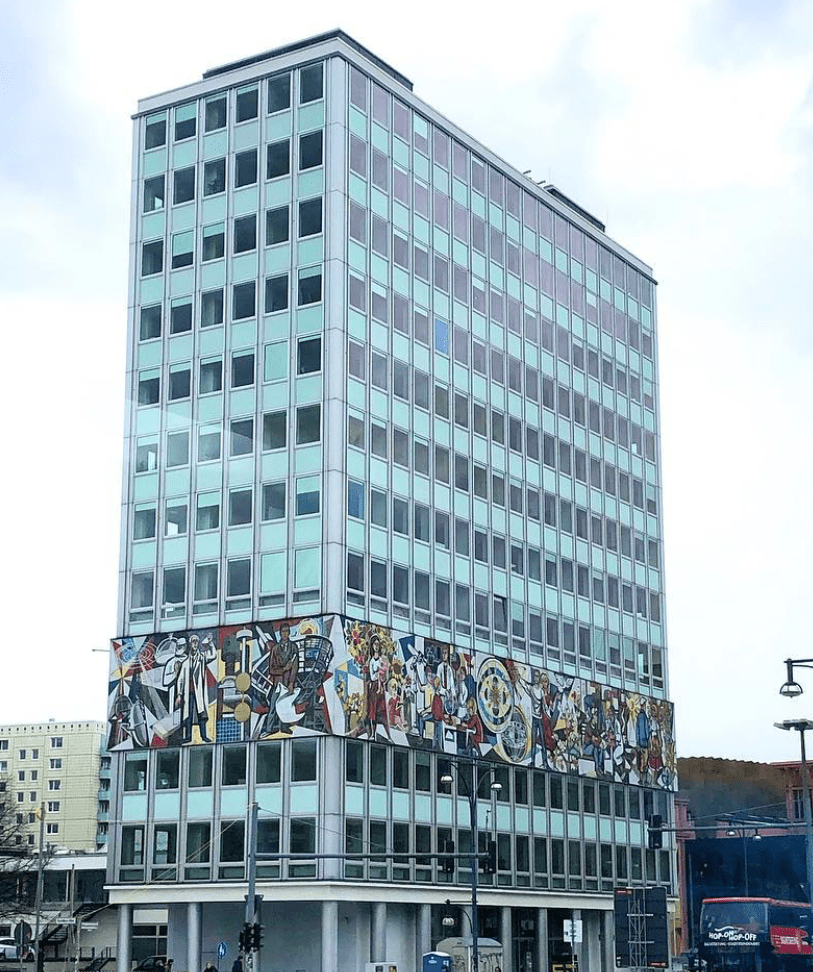
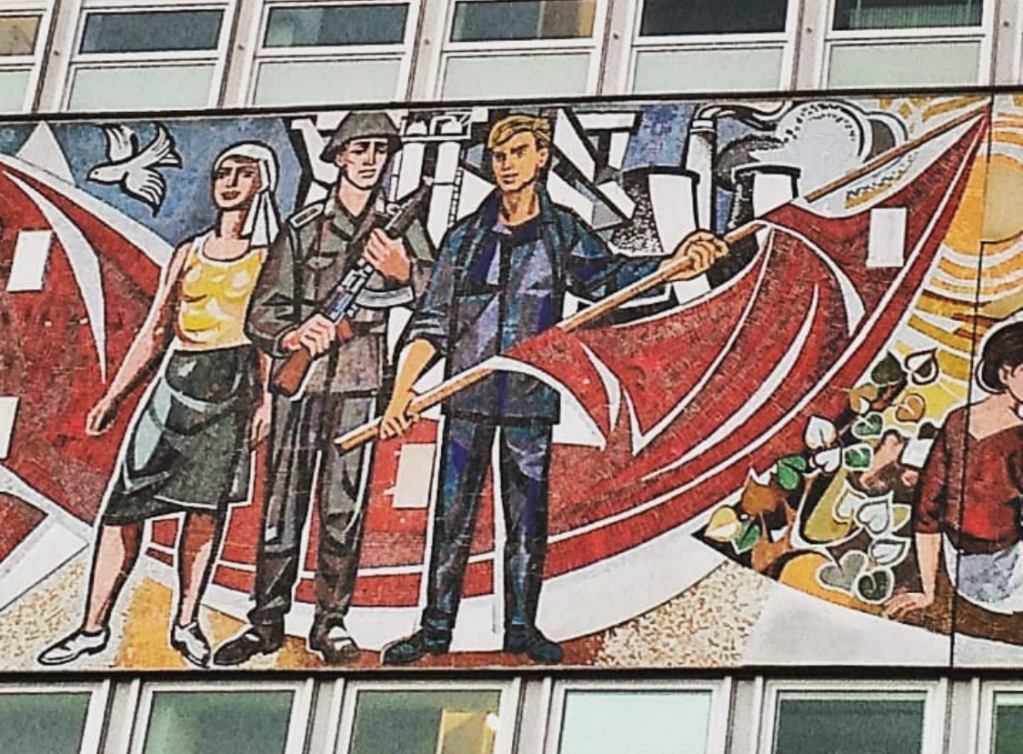
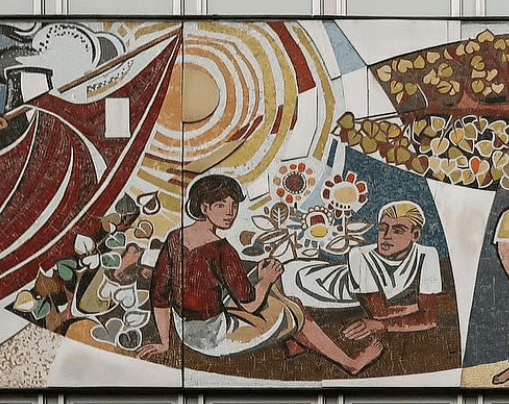
Art on buildings, among other public places, was a big thing for socialist countries – and in Berlin’s Alexanderplatz is one of the most iconic and largest of these artworks. It wraps around two floors of the East German Ministry of Education’s “House of the Teachers” building like a bandage.
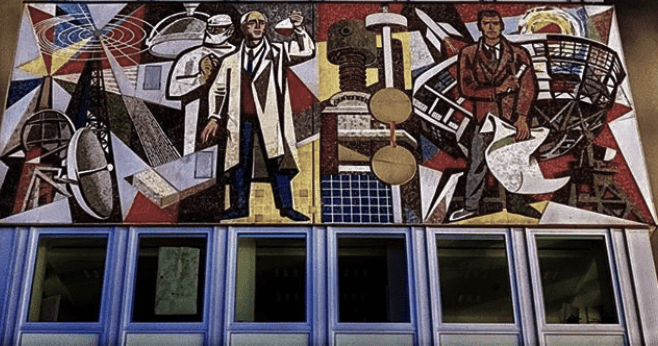
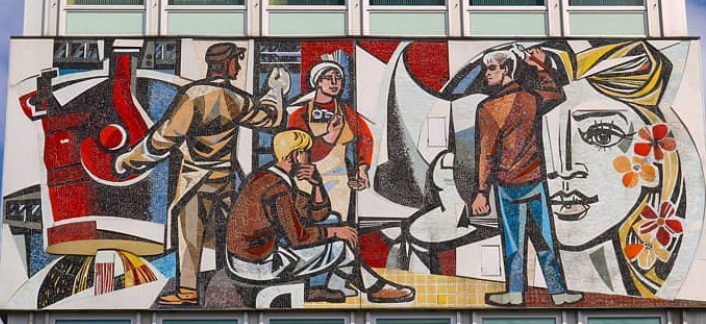
Artist Walter Womacka (1925 – 2010) was chosen by the East German government to make this mural – and the large-scale socialist realism mosaic built in 1964 is now a protected landmark. Its popularity probably stems from the colorful folk-art vibe which is so much softer and fun than hardline socialist propaganda art.Womacka called his mural with 800,000 tiles “Our Life,” and that’s precisely what it depicted – various aspects of life in East Germany that the government wanted to showcase.
One side depicts scientists and engineers, while another shows workers looking at an artist painting.This section of the mural depicts worldwide friendship and harmony
Sportsmen get flowers from admiring children, while farm workers chat with each other
A woman releases a symbolic dove, while a man waving the everpresent red flag is flanked by a soldier
Another section shows a couple relaxing in a garden – which is similar to Womack’s extremely popular work, On the Beach (1962).
(All images courtesy Instagram and Haus des Lehrers website).
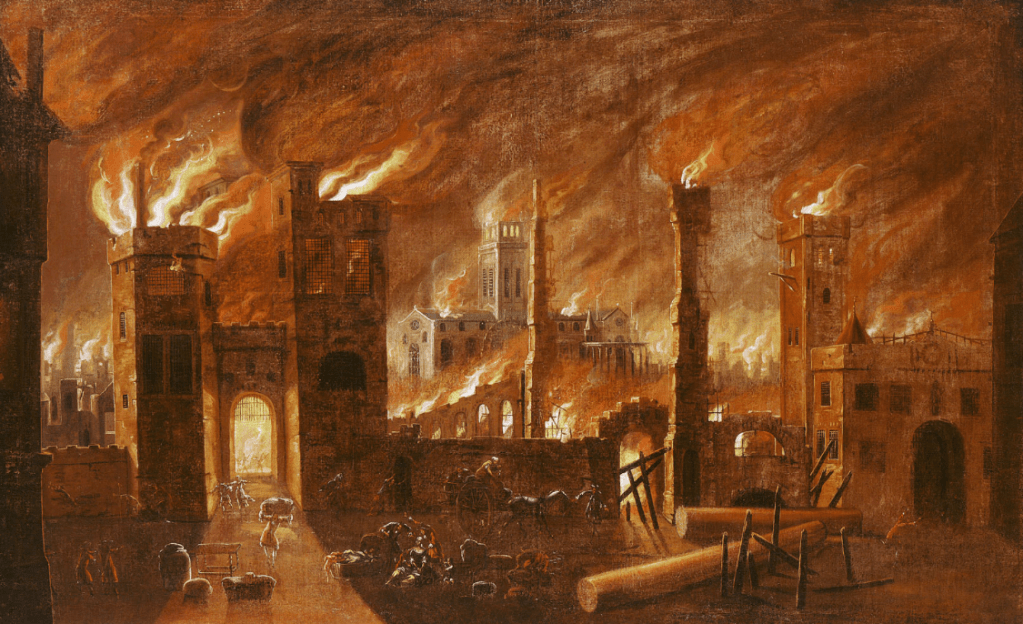
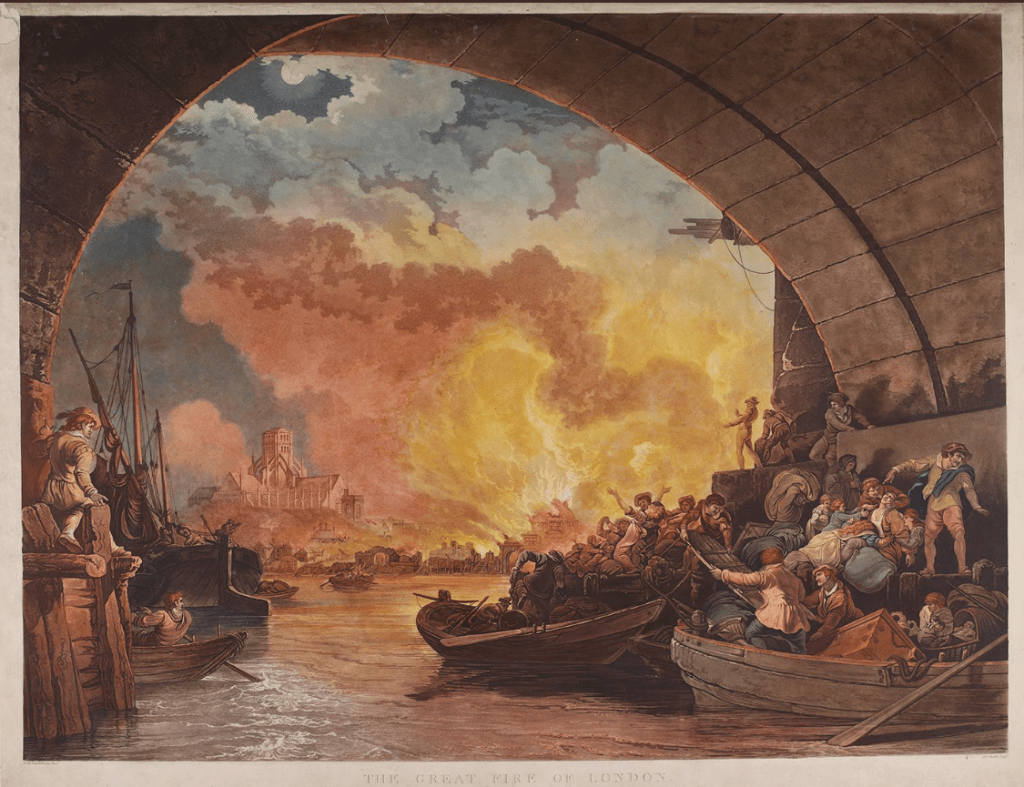
… By and by Jane comes and tells me that she hears that above 300 houses have been burned down to-night by the fire we saw, and that it is now burning down all Fish-street, by London Bridge. So I made myself ready presently, and walked to the Tower, and there got up upon one of the high places, Sir J. Robinson’s little son going up with me; and there I did see the houses at that end of the bridge all on fire, and an infinite great fire on this and the other side the end of the bridge; which, among other people, did trouble me for poor little Michell and our Sarah on the bridge.
Sunday 2 September 1666, Samuel Pepys
Great Fire of London, 1666 (Unknown Artist)
So down, with my heart full of trouble, to the Lieutenant of the Tower, who tells me that it begun this morning in the King’s baker’s house in Pudding-lane, and that it hath burned St. Magnus’s Church and most part of Fish-street already.
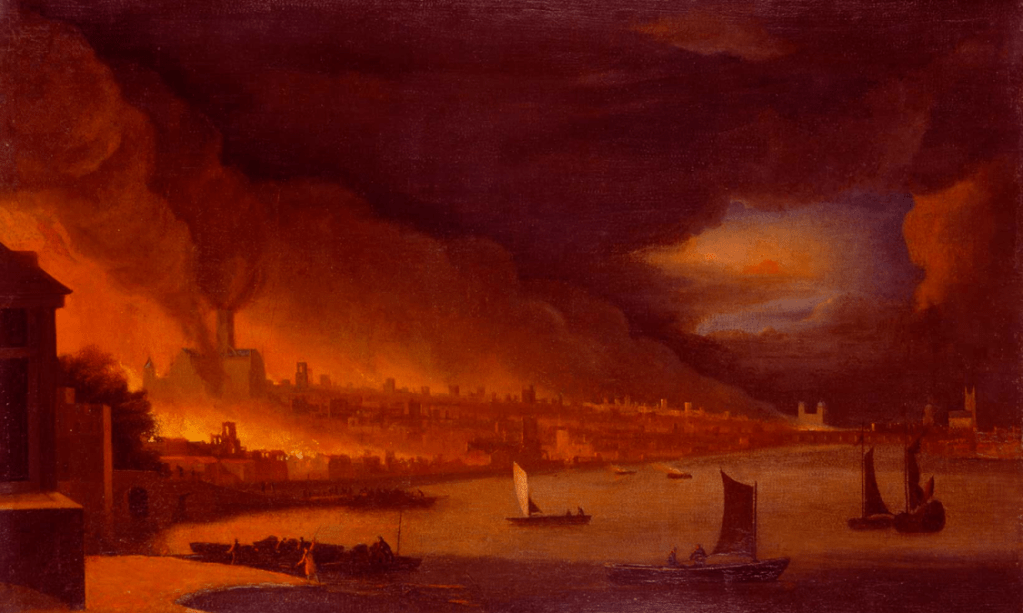
So I down to the water-side, and there got a boat and through bridge, and there saw a lamentable fire. Poor Michell’s house, as far as the Old Swan, already burned that way, and the fire running further, that in a very little time it got as far as the Steeleyard, while I was there.
Sunday September 2 1666, Samuel Pepys
Everybody endeavouring to remove their goods, and flinging into the river or bringing them into lighters that layoff; poor people staying in their houses as long as till the very fire touched them, and then running into boats, or clambering from one pair of stairs by the water-side to another. And among other things, the poor pigeons, I perceive, were loth to leave their houses, but hovered about the windows and balconys till they were, some of them burned, their wings, and fell down.Having staid, and in an hour’s time seen the fire: rage every way, and nobody, to my sight, endeavouring to quench it, but to remove their goods, and leave all to the fire, and having seen it get as far as the Steele-yard, and the wind mighty high and driving it into the City; and every thing, after so long a drought, proving combustible, even the very stones of churches, and among other things the poor steeple by which pretty Mrs. ———— lives,…..
Lord! what sad sight it was by moone-light to see, the whole City almost on fire, that you might see it plain at Woolwich, as if you were by it….I up to the top of Barking steeple, and there saw the saddest sight of desolation that I ever saw; every where great fires, oyle-cellars, and brimstone, and other things burning. I became afeard to stay there long, and therefore down again as fast as I could, the fire being spread as far as I could see it;
Thursday September 5, 1666 Samuel Pepys
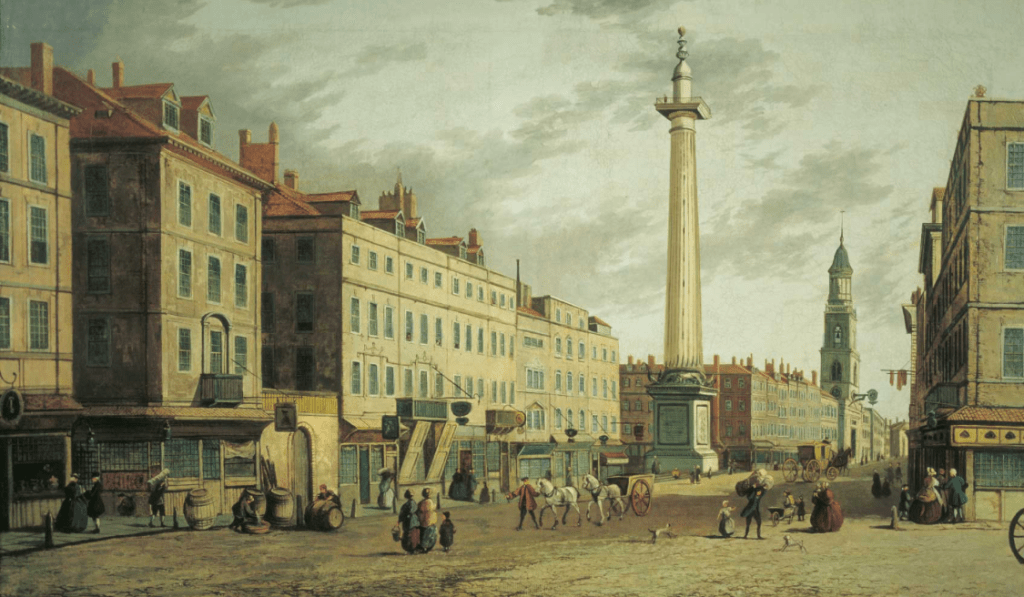
Up by five o’clock; and, blessed be God! find all well, and by water to Paul’s Wharfe. Walked thence, and saw, all the towne burned, and a miserable sight of Paul’s church; with all the roofs fallen, and the body of the quire fallen into St. Fayhth’s; Paul’s school also, Ludgate, and Fleet-street, my father’s house, and the church, and a good part of the Temple the like.
Friday 7 September 1666 Samuel Pepys
Canaletto, The Monument from Gracechurch Street (1750): monument to the Great Fire of 1666
(All images courtesy Museum of London, Guildhall Art (London), and pepysdiary.com)
This summer, I participated in a New York Times Reading contest which involved reading an article and writing a personal reflection to the article. The article I wrote about is by Alex Vadukul, “How Big Mike, a Barbershop painter, Broke into the Art World.” Mike Saviello works at a barber shop and during his lunch break he paints. Here is my reflection on this article:
If you scroll past all the stories of immigrants, dreamers, migrant crisis, political debates, you will come to this truly heartwarming story of Mike Saveillo, a barber from New York who has become a sought after artist. This too is a story about America: about the opportunities that still exist, about simple working class people, about cities like New York with long lasting barbershops, about wives who get cancer and husbands who get shattered, about barbers who dare to dream and use bold colors and have art showings at big name galleries – all of this is possible because Mike Saveillo lives in America.
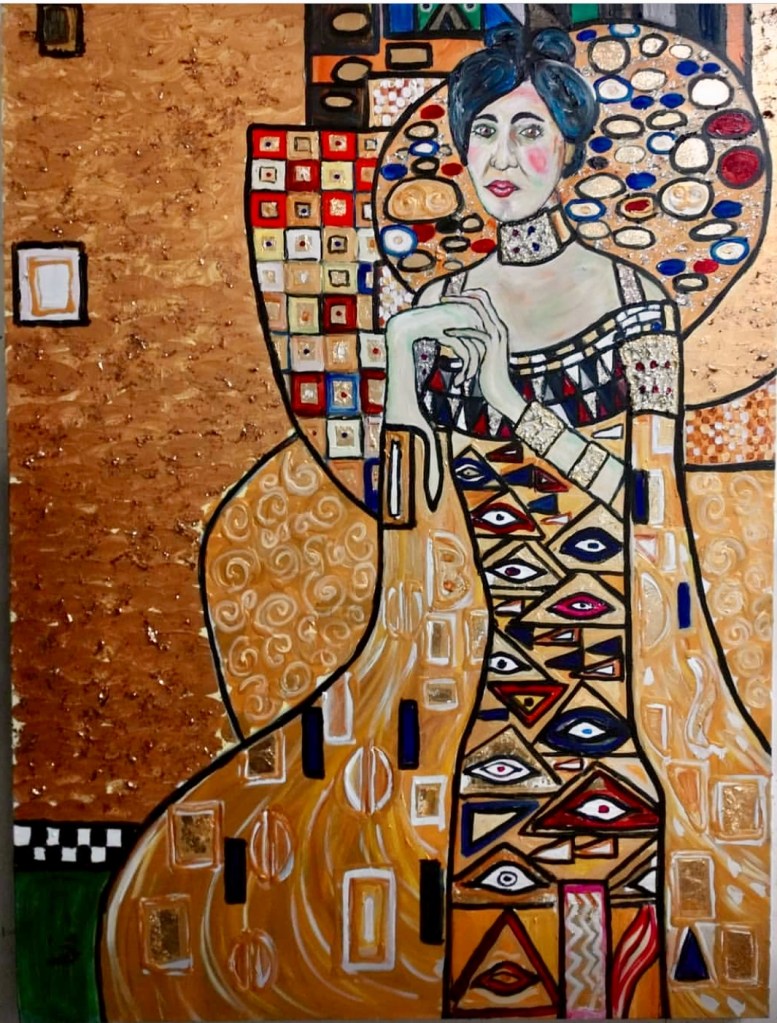
Harriet in Gold (for his daughter Harriet, inspired by Klimt)
Biggie Smalls
There is a Mike in most people. People often give up on something they are passionate about because it is the practical, sensible thing to do. We stop playing the cello because it interferes with math tutoring, we give up singing for science fairs. Mike gave up art for football, and then a well-paying job so he could support his family. But his passion for art never left him, and in the end he found a way to paint. That’s why I liked this story so much. Because in the end, Mike found a way to do something he had always wanted to do since he was a child, and because he lives in a country where he could dare to dream, and to be, in the words of his wife, “a disrupter.”
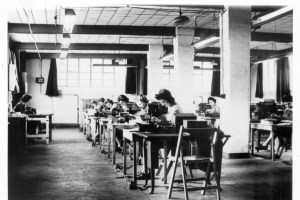
Eighty years ago on August 31, the German army invaded Poland and started World War II. I was watching some movies about World War II and came across “The Imitation Game,” which was about scientists and mathematicians that worked at top-secret Bletchley Park. As a student in London, my sister was lucky enough to visit Bletchley Park, and wrote the following vignette:
The really striking thing about England, particularly to an outsider, is how much of its national character is shaped by the two world wars, particularly World War II. It seems that no family was left untouched by the war, and every sacrifice, great and small, that can be made for a nation, was made. The number of young lives lost is incomprehensible, and the number would have been much larger but for the brilliant people who worked at Bletchley Park.
It is often said that truth is stranger than fiction – it is at least true in the case of Bletchley Park. If you put all the spy movies, thrillers, and novels together, they would still not match the intrigue of Bletchley Park, its intense secrecy, its brilliant people, and the unbelievably intelligent decoding and deciphering work that was done here during World War II. The fact that toward the end of the war over 8000 people worked here and yet its existence was not disclosed until decades later, gives an inkling of the level of secrecy maintained, and the characters of the people that worked here. The mathematicians at Bletchley Park were deciphering Germany’s war time communication codes, and to do this they built the world’s first computers. These brilliant people were able to decipher Germany’s supposedly indestructible codes and in the process saved many lives including at Dunkirk, D-Day, and were instrumental in finding Germany’s most powerful warship Bismarck so the British Navy could drown it.
After the war, Bletchley Park and its brilliant people all went home, and never spoke a word because of the oath of secrecy they had all taken. Many had parents that died without knowing their son or daughter’s immense contribution to the war effort. Clearly this was a generation of greatness. How did we get from there to our current generation of selfies, Facebook, Instagram – we can barely drink a cup of tea without informing the whole world about it. Over 8000 people. Over three decades. Not one word. Let that sink in, and perhaps one begins to understand England.
European Space Agency’s astronaut Andre Kuipers took this photograph of Berlin from space. This image as well as Canadian astronaut Chris Hadfield’s image and tweet brought attention to the marked difference in Berlin lights at night when he saw it from space in 2013.
Chris Hadfield took this picture from space, “Berlin at night. Amazingly, I think the light bulbs still show the East/West division from orbit.” April 17, 2013. (Twitter).
On April 13 2013, it was 23 years 5 months and 4 days since the Berlin Wall fell – so why this difference?
East Berlin’s street lights were a sodium vapor lamp which emit a soft yellow light, whereas West Berlin has fluorescent lights which emit white light. Apparently, the reunified city government had not gotten around to changing the East German lights yet!!
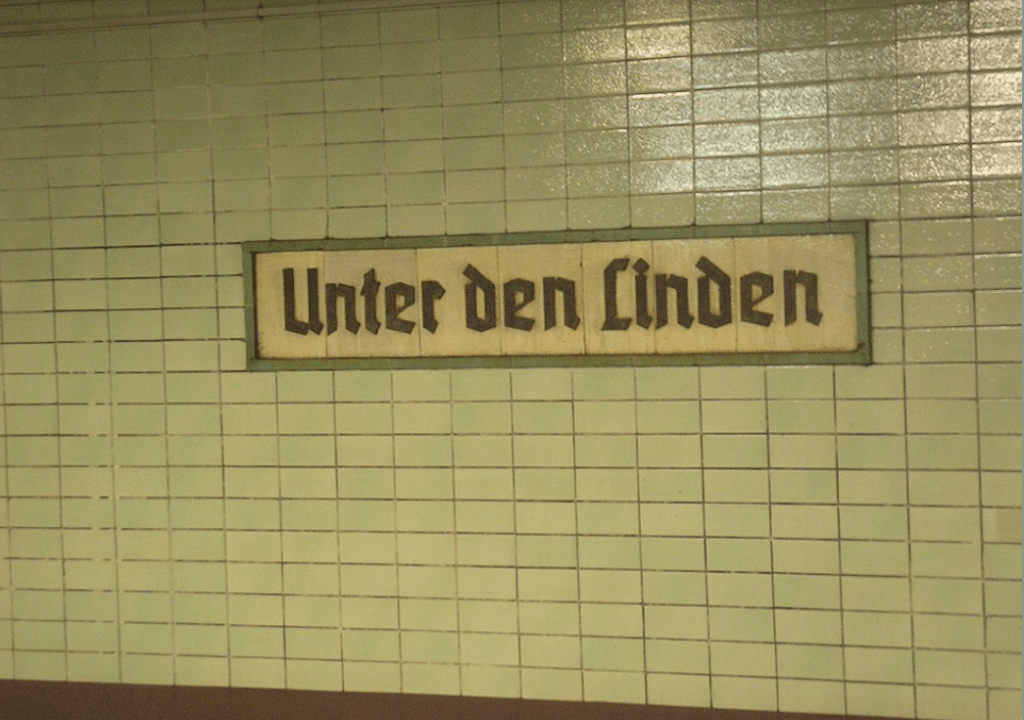
The brightly lit up blob in the center which looks like it’s in the East is Alexanderplatz which was heavily renovated after reunification and hence shows white light. The oval shaped darkness at the 9 0’clock spot is the Tiergarten, and the lit up line running through it is a major road, Unter den Linden, which leads to the well-lit Brandenburg gate.
The legendary Tempelhof Airport is now a park.
At around the 3 o’clock spot there’s another dark circle – that is the legendary Tempelhof Airport – the site of the Berlin airlift where American cargo planes brought in food and other supplies to the city when it was blockaded from all sides by the Soviet Union. The airport is now a park.
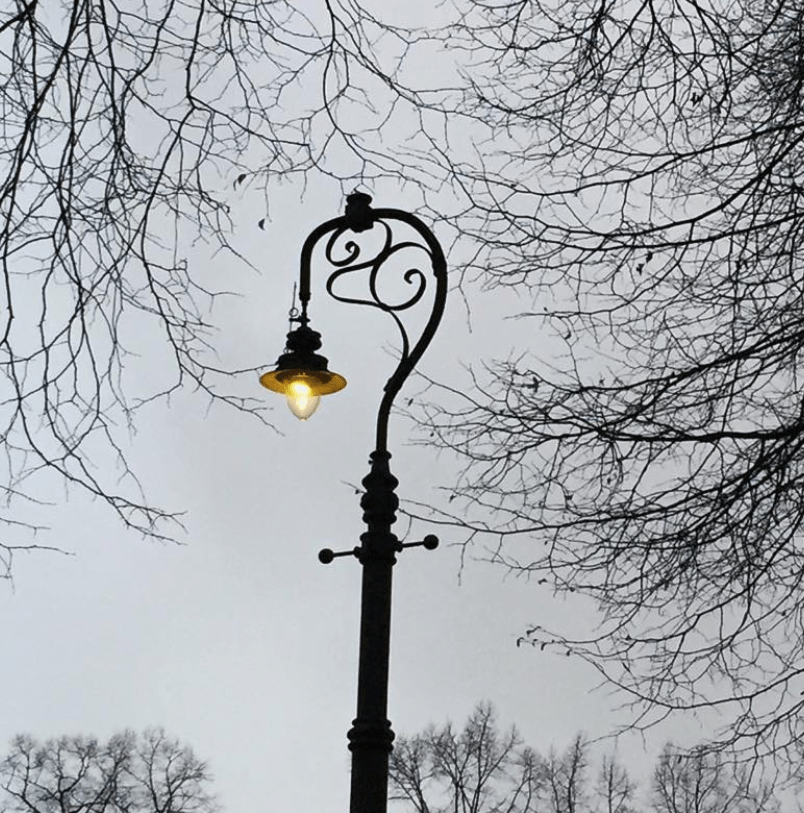
Belin is home to some of the most beautiful streetlights, some of which have been around the mid 1800s. It seems that the remaining 30,000 streetlights are set to be replaced with more energy and environmentally friendly street lights. Many Berlin residents are trying to get a UNESCO World heritage classification for the old streetlamps in an effort to save these beautiful lamps.
Pop Art gave America some of its most well-known and beloved artists and iconic paintings, and proved to be a form of self-affirmation for a young nation still looking to old European masters for inspiration and approval. Andy Warhol (1929-1987), whose name has become synonymous with Pop Art is the leading figure of this movement. His creative peak was between 1962 and 1968, when he produced a series of paintings which proved to be the high-point of the pop art movement.
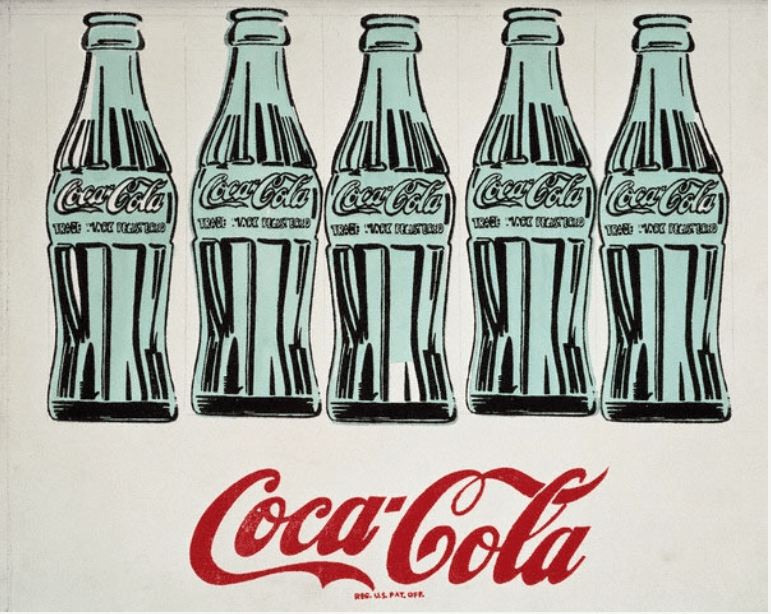
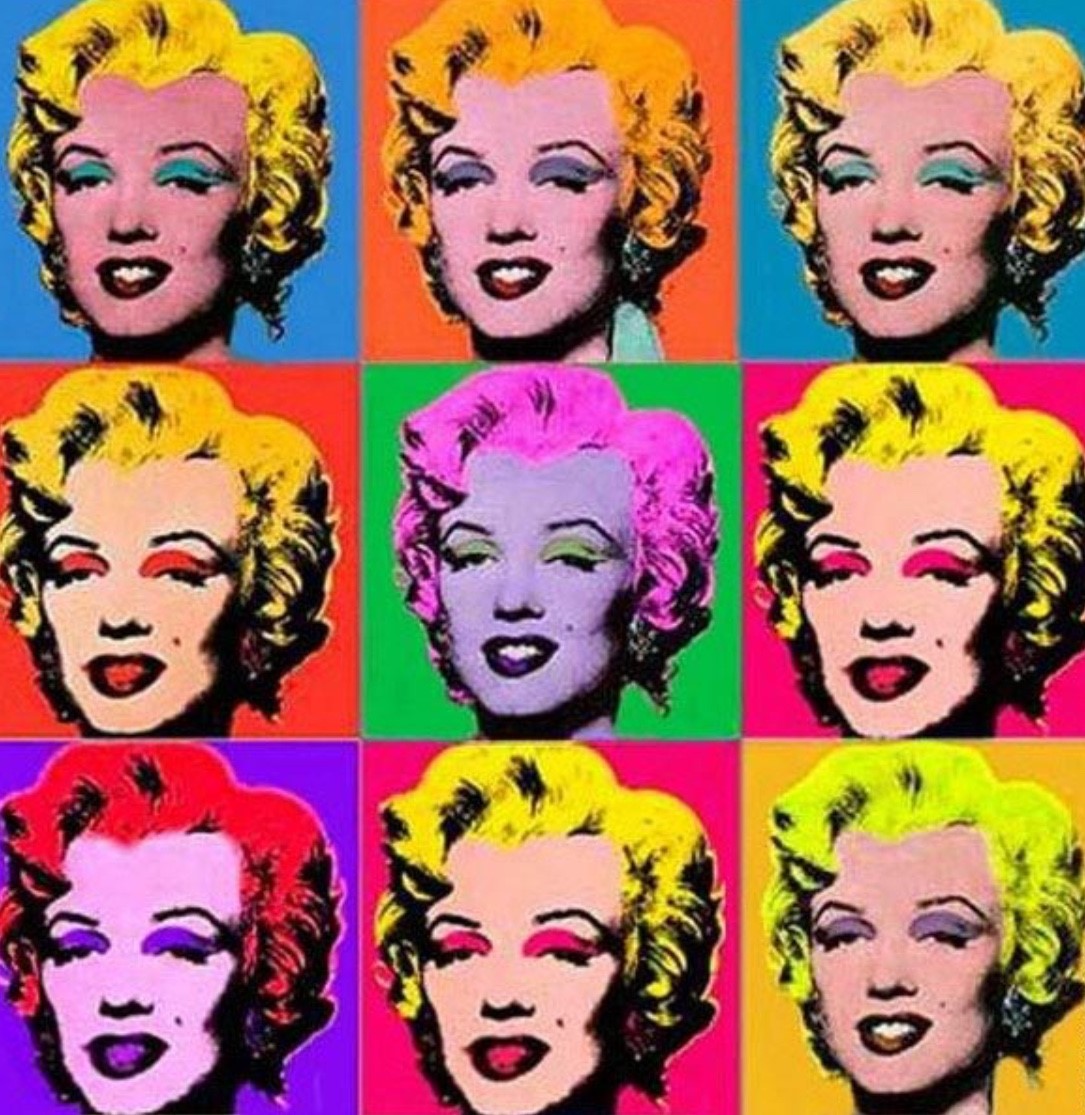
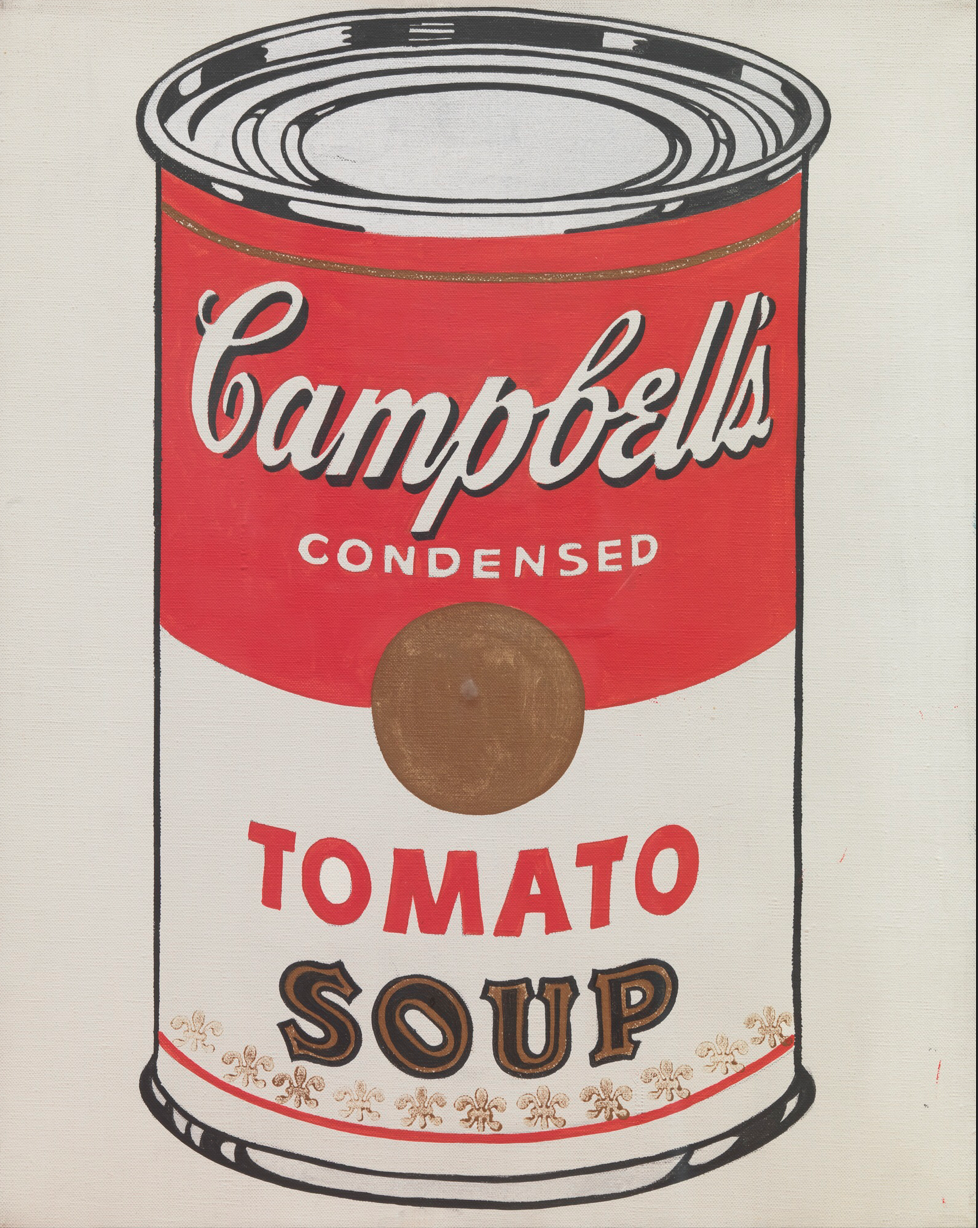
Having had a previous career in advertising, Warhol favored commercial techniques, and was keenly aware of the way imagery could be manipulated. His soup tin and head of Marilyn Monroe with which he has become inextricably linked are considered pop art icons. In Marilyn Monroe (1964), Andy Warhol painted twenty-five images of Marilyn Monroe emphasizing how easily the image can be mass produced. A closer look, however, reveals that each head varies slightly from the next, “here the eye shadow is darker, there the hair is lighter, in another place the lips are smudged.” (John Sandberg, Art Journal). In Campbell’s Soup Cans (1962), by removing soup tins from the supermarket aisle and placing them in a new setting, Warhol changed the way America looked at art.
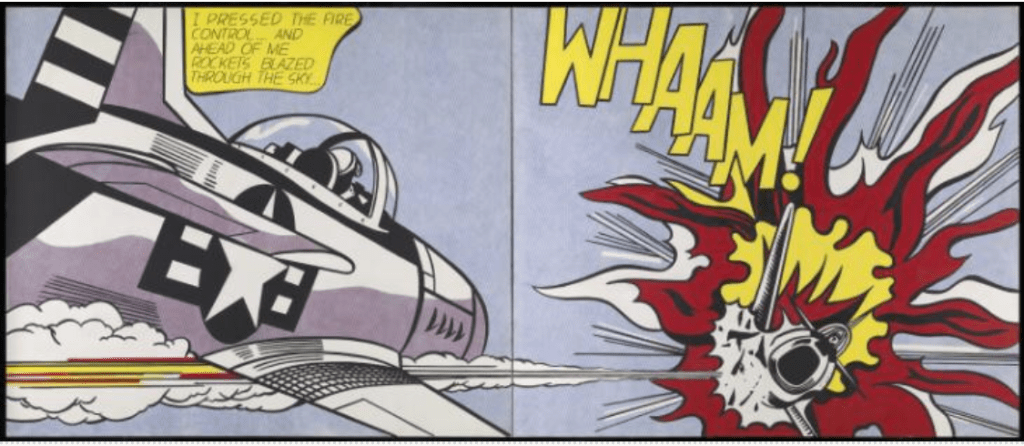
Roy Lichtenstein, Whaam! 1963
Roy Lichtenstein, Drowning Girl, 1963
Another groundbreaking pop artist, Roy Lichtenstein (1923-1997) looked to comic strips for inspiration right down to the Benday dots used in cheap comic strip printing. With Whaam! (1963), Lichtenstein took a highly charged subject matter and shows it in a completely detached emotionless way. According to Tate Modern, this was commercial art in a fine art context. In the melodramatic Drowning Girl (1963), he copied a comic strip right down to the dots.
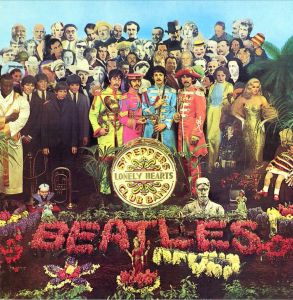
Peter Blake, Beatles Album Cover
British Pop Art, though inspired by America was less brash. It seems softer and bordered on nostalgia. Peter Blake (b. 1932), a member of the avant-garde British pop artist Independent Group, whose original claim to fame was the co-creation of the Beatles’ Sgt. Pepper’s Lonely Hearts Club Band album cover, is a leading figure in British pop art. In one of his most well-known works Self-Portrait with Badges (1961), Blake pays homage to tradition with the badges, and to popular culture, particular American culture, with baseball shoes, denim fabric, and the magazine dedicated to Elvis Presley who had just become famous in Britain (Tate Modern).
Peter Blake, The FIrst Real target, 1961
In The First Real Target (1961), in true Pop Art fashion, an everyday item becomes an item of visual interest. Moreover, by alluding to American pop artist Jasper Johns, who is known for painting targets, Blake acknowledges the appeal and influence of American pop art and popular culture.
The Pop Art movement faded away by the end of the 1970s, but left its mark on the art world. It made ordinary, recognizable objects into visual art and paved the way for artists to explore the nature of art which in turn led to experimentation and art movements such as Postmodernism, Photorealism, and Neo-Expressionism.
Ia short span of less than two decades, Pop Art unchained the fine art, highbrow shackles that had chained art for centuries, and made it fun, vibrant, colorful, relatable, and democratic. The movement’s most enduring legacy, however, is that it has made the world a little less rigid, and a little more tolerant and open-minded. It showed the world that there is more than one way of seeing things, and in so doing, forever changed the way the world looks at art.
The glorification and elevation of a soup tin to high art could only happen in a country that was the birthplace of democracy and considers the pursuit of happiness a national pastime. The generation that grew up in war time was clearly going to be different from previous generations, and this was evident in almost every aspect of their lives. There was a sense of impermanence, and the desire to enjoy life for the moment. When the children of the people who fought in the war became adults, they lived life on their own terms; changed their hairstyles, shortened their dresses, removed hats and collars, listened to music that was definitely not their parents’ music, and freed art from the shackles of fine art and refinement.
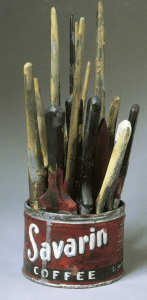
Jasper Johns, Painted Bronze 1960
In their adulthood, by the late 1950s, America was a place of affluence and material wealth. Families purchased new age gadgets like automobiles and televisions, moved to the suburbs, and lived a consumerist life. Capitalism in society also inspired the art movement known as Pop Art which started in the late 1950s and lasted until the 1970s. The movement was mainly limited to the United States and Britain, and its most defining feature was that it took art lightly and turned to mainstream media and culture for inspiration.
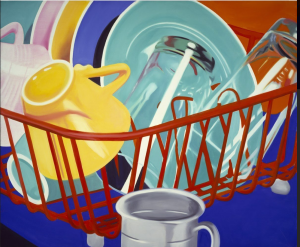
James Rosenquist, Dishes, 1964. Oil on Canvas
The art world’s immediate reaction to World War II was to turn inward to an art movement that eventually came to be known as Abstract Expressionism. By 1960s, the artists who grew up with and learned their trade from the abstract expressionists were ready for a change. And since no conventional realism would do, the answer came in the form of Pop Art – this happy medium of abstract and realism, which is both and neither at the same time, was coined “Pop Art,” by British art critic Lawrence Alloway in 1951 referring to the pop culture of the era.
Roy Lichtenstein, In The Car, 1963, Oil and Magna on Canvas
Pop Art was a product of its times. By the 1960s, the US was a consumer goods society with mass media extensively promoting material goods to a society looking to increase its material possessions. Pop Art looked towards the graphics and images from advertisements and other forms of mass media for inspiration. Mass media had already perfected images to sell products to the American public and Pop Art elevated these images further by putting by elevating them to an art form; what art critic described aptly as gilding an already gilded lily. In the UK too, a public tired of war rations and shortages wanted to reap the material benefits and affluence so seductively presented in American films and magazines.
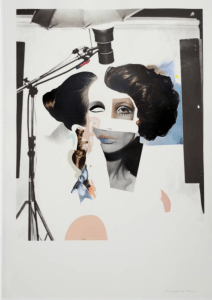
Richard Hamilton, Fashion-Plate, 1969 – 1970
Among contemporary art movements, Pop Art, with its bold, bright colors, is one of the most instantly recognizable styles of art. Pop Art blurred the distinction between fine art and commercial art by turning to banal, everyday items for inspiration. This art movement captured everyday items such as ice cream cones, soup cans, billboards, and comic strips and recorded a moment in time of American life. Pop art presents realistic images of these items, but not in the conventional sense; the enormous sizes, though not unrecognizable, are sufficiently transformed by the artist to be no longer realistic.
James Rosenquist, The Facet 1978
The revolutionary group of artists who worked in Pop Art were not only rebelling against the status quo in the art world, they were also affirming the post-war capitalist boom in America. Similar to previous generations of artists who recorded the ever changing contours of the great American outdoors, the avant-garde group of pop artists sought to capture the transient nature of the subject matter they painted. Among the most well-known were Andy Warhol, Roy Lichtenstein, James Rosenquist, Jasper Johns, and Robert Indiana. British pop artists, who were influenced by American culture from a distance, included Richard Hamilton, David Hockney, and Peter Blake.
In my next blog I’ll write about three of these artists, their works, and some concluding remarks about this art movement.
“If you name me, you negate me. By giving me a name, a label, you negate all the other things I could possibly be.” Danish Philosopher Soren Kierkegaard (1813 – 1855).
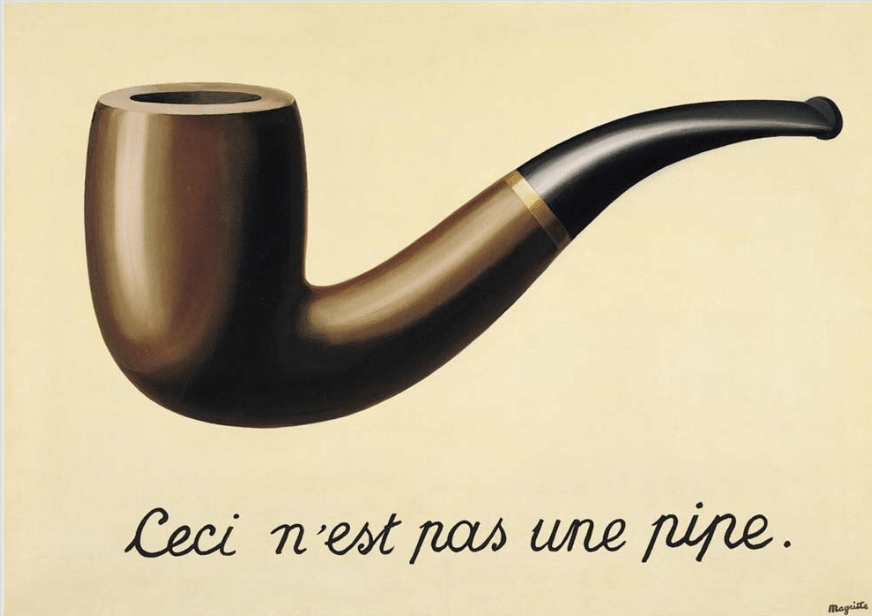
Rene Magritte (1898–1967) was a Belgian surrealist artist who is known for challenging the viewers’ preconditioned perceptions of reality.One could wax and wane endlessly about the philosophical underpinnings of his pipe painting, Treachery of Images (1929). Or the way I understand it – Magritte was saying two things here – this is not a pipe since you can’t really stuff some tobacco into it and smoke it as you would a pipe. The second is that it’s not a pipe because it’s an image of a pipe. And really the word pipe can be changed at any time to say for instance pig – in which case – this would still no longer be a pipe. So the word and the image are simply representations of the real thing, and not the real thing.
The Interpretation of Dreams 1935
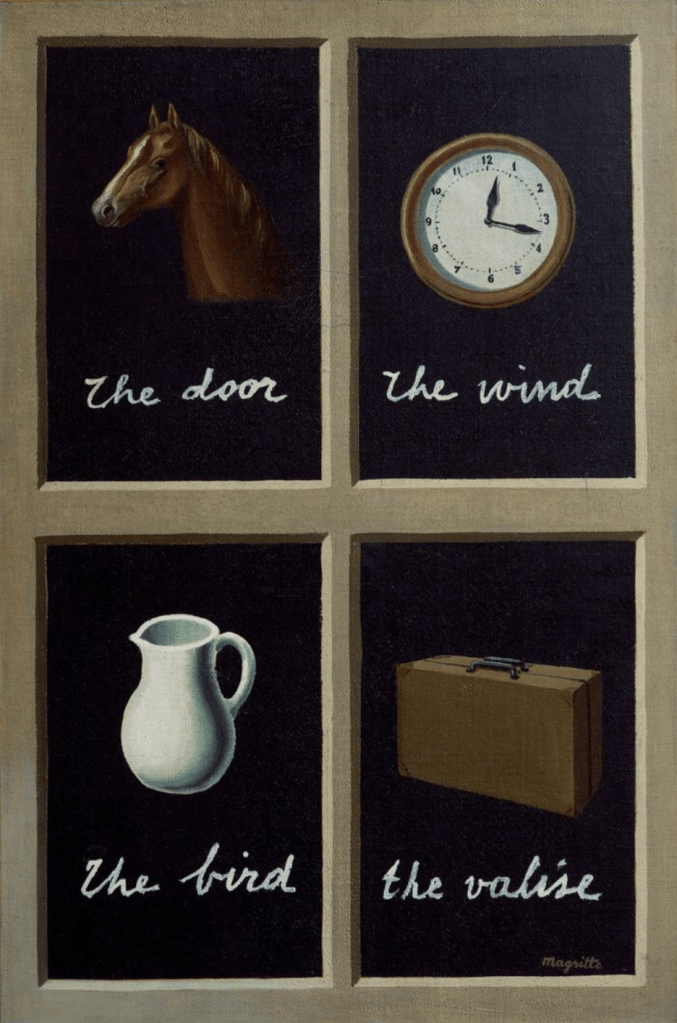
Words and images are human representations of the real live tangible thing which we can touch and experience. They have names because we gave them these names – there is always a disconnect between the real thing and the way we see and name something – perhaps that’s why the images are also painted through a window.
Key to Dreams 1927 …the sky, the bird, the table, the sponge
The paintings are depictions of the challenges put forth by the influential Swiss linguist Ferdinand de Saussure (1857-1913) who clearly saw that the relationship between a thing and its name are totally arbitrary. The word gets its meaning from existing within a context of the system of naming that exists and has existed for centuries. Magritte challenged this same arbitrary relation in these paintings.
The Key To Dreams, 1930 …. the acacia flower, the moon, the snow, the roof, the storm, the desert
So Magritte, Kierkegaard, & de Saussure come together to help us understand and challenege, and find new ways of looking at old things.


























 mimisawhney.com