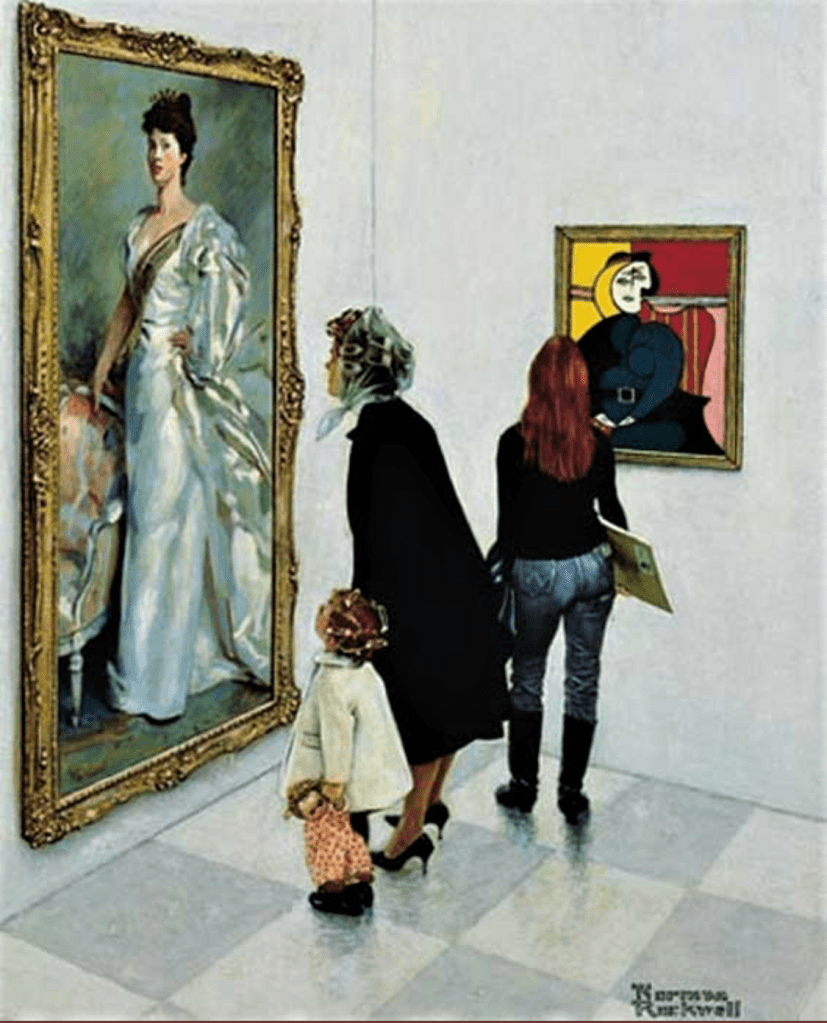
I came across this fascinating work by Norman Rockwell last week, and was intrigued by overall subject matter, and the paintings in the painting – shown in this work. Rockwell did this work titled, “Picasso vs. Sargent,” for the January 11, 1966 edition of the LOOK magazine.
The painting by Rockwell shows two paintings in the same room of a museum. The first painting, on the left wall is an 1897 portrait of Mrs. George Swinton by John Singer Sargent, whereas the second painting is Picasso’s 1931 painting, “The Red Armchair.” Two very differently dressed women – representing different versions of femininity and women’s liberation – are looking at the two very different paintings, and we are not surprised by which lady is looking at which painting.


The era seems to be the threshold of time in between the 1950s and 1960s, when women moved out of the kitchen and into the workforce. They changed the way they dressed – feminine dresses and overcoats gave way to jeans and leather jackets, heels were discarded in favor of leather boots, and curlers were tossed in favor of natural relaxed hairstyles, Perhaps, children too are being traded for portfolios – as more and more women enter the workforce, they delay having children.
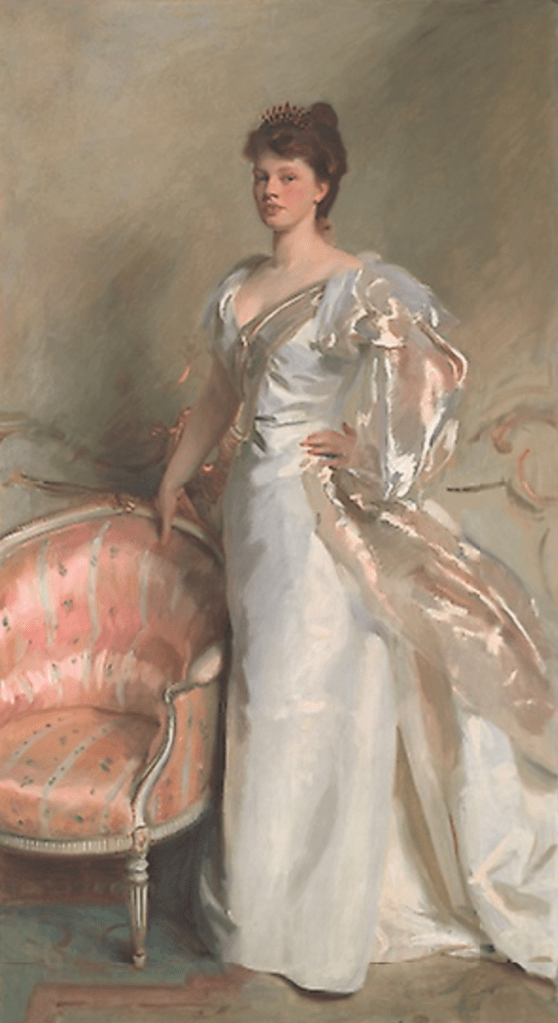
The portrait of Mrs. George Swinton can be found in the Art Institute of Chicago’s American Art Gallery. The painting, with its extravagant color and brushwork, epitomizes why Sargent as the leading portraitists of his time. According to the Art Institute, “he accentuated her regal bearing and feminine dress. Sargent harmonized the realism of her face and body with bursts of impressionistic brushstrokes describing the shimmering, translucent fabric descending from her shoulder.”
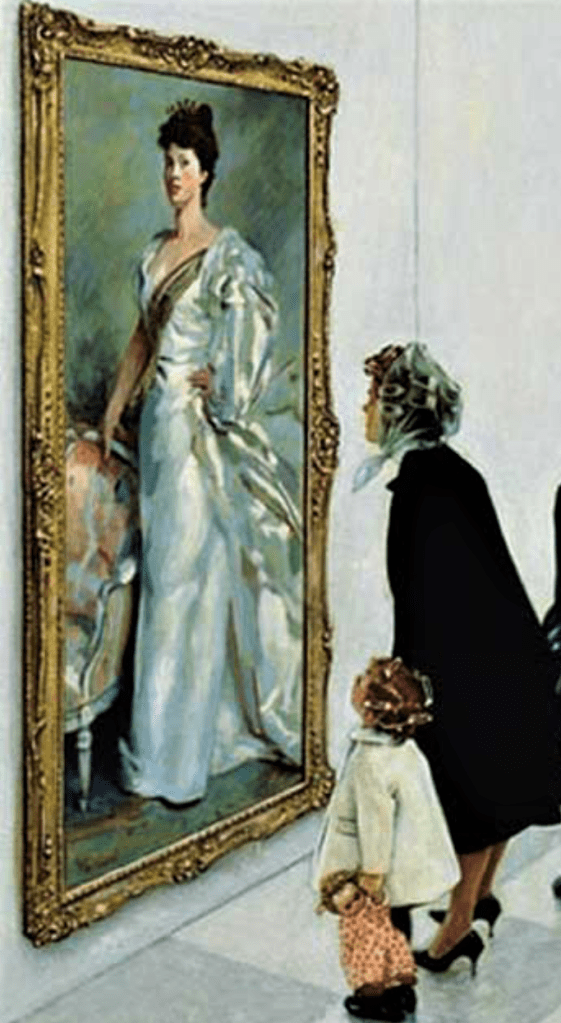
In Rockwell’s painting, a woman and her little daughter are looking at the beautifully framed Sargent painting. The woman, daughter, and the doll – all three – strangely, have curlers in their hair. Apart from this anomaly, the mother is exquisitely and formally dressed in an overcoat, and heels, while the daughter is also wearing a young child’s dressy overcoat.
Picasso’s, “The Red Armchair,” is a portrait of Maris Therese-Walter – by whom a much older and married Picasso was smitten. According to the Art Institute of Chicago, which also owns this painting (in its Modern Art Gallery), “the smitten artist began to furtively reference her blond hair, broad features, and voluptuous body in his work. Perhaps acknowledging the double life they were leading, he devised a new motif; a face that encompasses both frontal and profile views.”


Of note here is also how well Rockwell has copied the very different works of Sargent and Picasso.
On the surface, this is such a fun painting of a visit to a museum. But a detailed look reveals a painting full of subtle messages, and this beautiful, almost poignant, painting captures a moment in American history and records it for posterity.




 mimisawhney.com