Mayflower

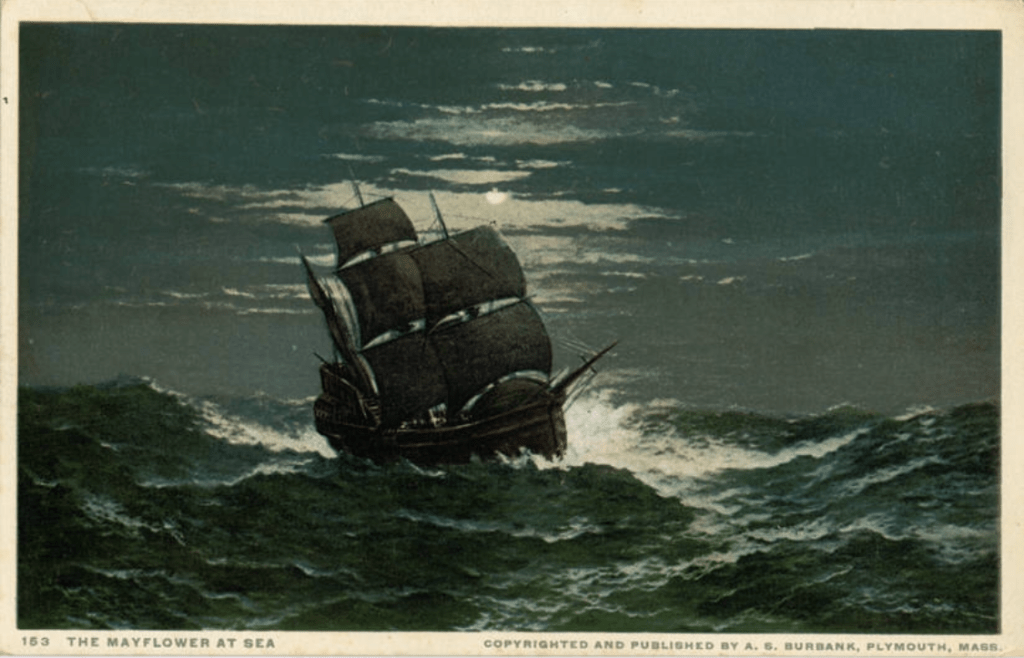
Methinks I see it now, that one solitary, adventurous vessel, the ‘Mayflower’ of a forlorn hope, freighted with the prospects of a future State, and bound across the unknown sea. I behold it pursuing, with a thousand misgivings, the uncertain, the tedious voyage. Suns rise and set, and weeks and months pass, and winter surprises them on the deep, but brings them not the sight of the wished-for shore. I see them now scantily supplied with provisions, crowded almost to suffocation in their ill-stored prison, delayed by calms, pursuing a circuitous route; and now driven in fury before the raging tempest, on the high and giddy waves. The awful voice of the storm howls through the rigging. The laboring masts seem straining from their base; the dismal sound of the pumps is heard; the ship leaps, as it were, madly from billow to billow; the ocean breaks, and settles with engulfing floods over the floating deck, and beats with deadening weight against the staggered vessel. I see them, escaped from these perils, pursuing their all but desperate undertaking, and landed at last, after five months’ passage, on the ice-clad rocks of Plymouth,—weak and weary from the voyage, poorly armed, scantily provisioned, depending on the charity of their shipmaster for a draft of beer on board, drinking nothing but water on shore, without shelter, without means, surrounded by hostile tribes.

Edward Everett, Plymouth, December 22, 1824

Sunday Seven – Shimon Peres

Shimon Peres, distinguished politician, statesman, and Nobel laureate was born on this day in 1923. He served as both prime minister and president of Israel. He was awarded the Nobel Peace prize for his “efforts to create peace in the Middle East.” This week’s Sunday Seven Quotes are from his speeches and his books:

  • We should use our imagination more than our memory.
  • If you eat three times a day you’ll be fed but if you read three times a day you’ll be wise.
  • If a problem has no solution, it may not be a problem, but a fact – not to be solved, but to be coped with over time.
  • If an expert says it can’t be done, get another expert.
  • When Israel was weak, I worked to make her fierce. Bot once she was strong, I gave my life’s efforts to peace.
  • Peace is a purpose – a goal worthy of the chase, while war is a function – born out of necessity.
  • You don’t make peace with your friends. You make it with your unsavory enemies.
  • It’s not enough to be up to date. We have to be up to-morrow.

15 August 1620

Edward Moran (1829 -1901), Embarkation of the Pilgrims from Southhampton 1620

It was 400 years ago today that two ships sailed from Southampton (UK) for America – Mayflower and Speedwell. The ships that left Southampton carried the Separatists and the Strangers.

Leaving Leiden, July 22, 1620

The Separatists had left UK because of religious persecution in 1608, and had settled in Leiden, Netherlands. After 12 years they were disillusioned by their life and their ability to practice religion freely and decided to move to America. They sold all their belongings, bought the Speedwell and sailed from Leiden for Southampton on July 22, 1620.

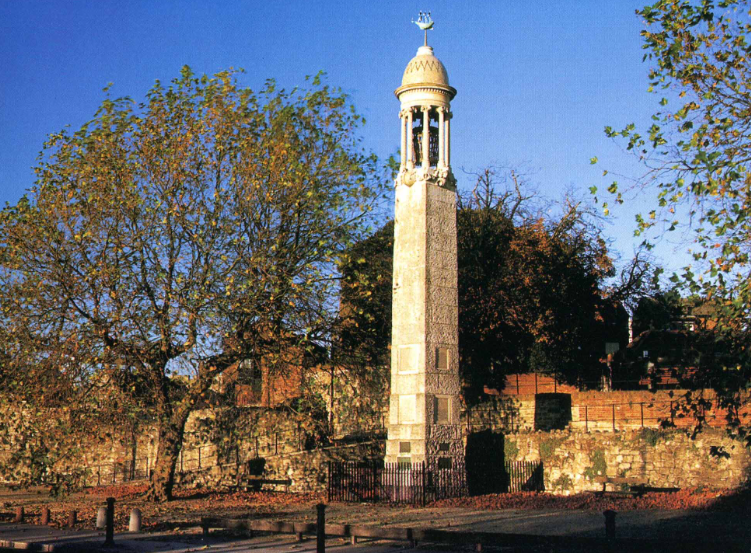
Pilgrim memorial Southampton, UK

They met up with more Separatists, and people who were moving for non-religious reasons, known as Strangers, in Southampton. The Speedwell had developed a leak in its journey from Leiden and needed repairs. While the repairs happened, the Speparatists lived on what is now known as Pilgrim Hill. They stocked up necessary supplies from merchants in Southampton before leaving on this long and unknown journey.

Arthur Welling Fowles (1815- 1883), Mayflower leaving Southampton 1881

It was on August 15, 1620, after Speedwell was fixed that both ships sailed. The journey, however, was cut short when Speedwell developed another leak after sailing for about 300 miles into the ocean. She was considered unsafe, and both ships turned around and headed towards Plymouth, UK.

Speedwell cannot make the journey

Speedwell had already been repaired, and at this point was considered not safe to make the transatlantic journey. Some Separatists abandoned the idea completely and returned to Leiden, other remained in Plymouth, and the rest got on board the iconic Mayflower which sailed into the ocean and into history a month later.

le Corbusier

Le Corbusier (1887 – 1965) was one of the most important and influential modern architects of the 20th Century, and is known for his works in the International Style – a style that crossed national boundaries post World War I in Europe.

Villa Savoye outside Paris is the icon of International Style and reflects le Corbusier’s “Purist ideals in its geometric design and avoidance of ornamentation” (Stokstad, Cothern). The house utilizes the 5 points of architecture considered essential for Modern architecture: 1)pilotis (free-standing posts)  that lift the building above the ground, 2)a flat roof that serves as a garden and terrace, 3)open plan interiors, 4)ribbon windows for light an ventilation, and5) a free façade independent of the load bearing structure.

Unite d’Habitation – Marseilles, France

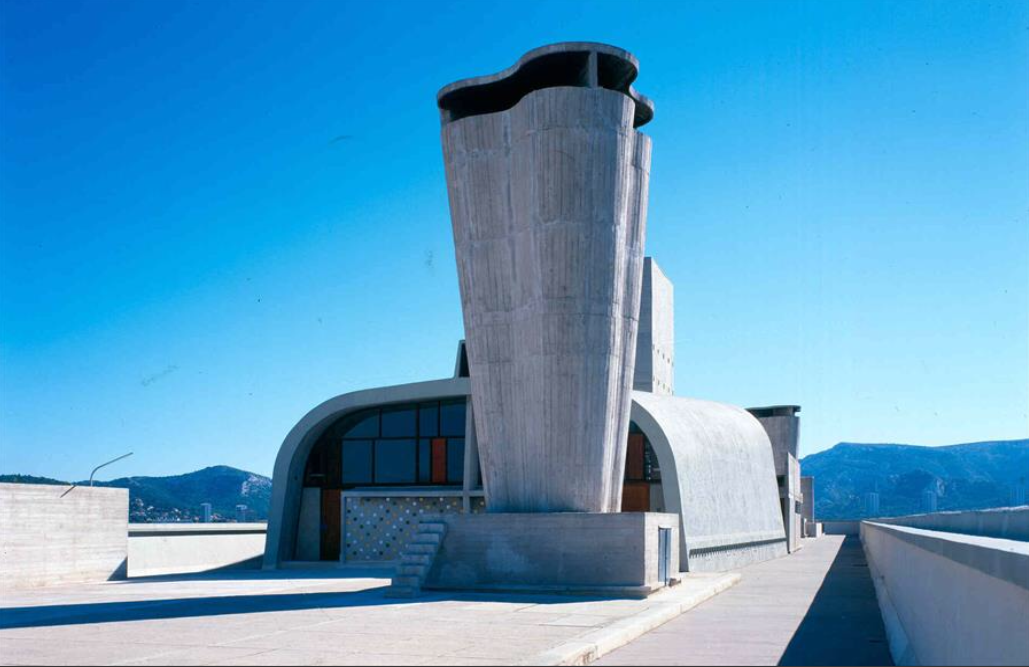
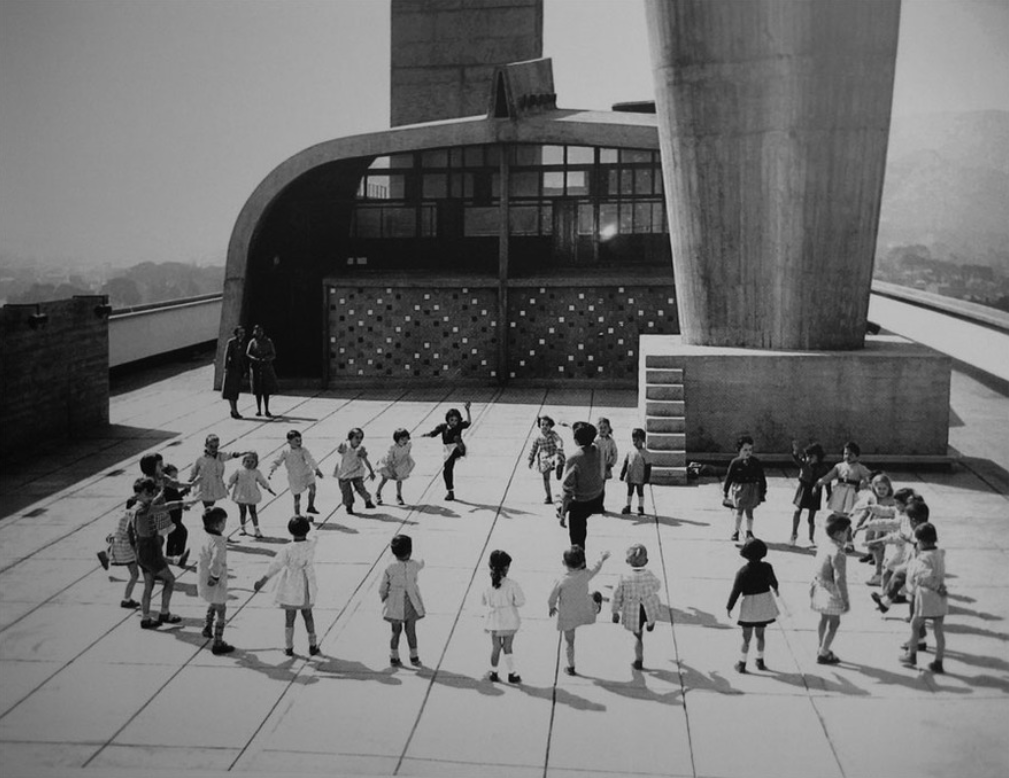
The Cite Radieuse (Radiant City) in Marseilles was le Corbusier’s post World War II multi-family housing project designed under Unite d’ Habitation design principle. It is also the building that inspired brutalist architecture. Completed in 1952, this vertical city of two-story residences and a communal rooftoop garden was built of beton brut because of steel shortages post World War II. The building is considered highly influential in the world of architecture and is one of the most innovative responses to the acute housing shortages after the war.

The city within a city boasts a kindergarten gym, and paddling pool on the roof deck, as well as shops , medical facilities, and a hotel inside the building. In all le Corbusier designed and built five Unite’ d Habitation housing developments in a span of 15 years– in Marseilles, Reze, Berlin, Briey-en-Foret and Firminy. These all-inclusive housing complexes represented an extraordinary moment in the development of housing in the 20th century.

(Images courtesy le Corbusier foundation).

A Rose by any other name..

I am always intrigued by names and how they originate and get associated with things. I thought I’ll research a few of my favorite flowers and see how they got the name they did.

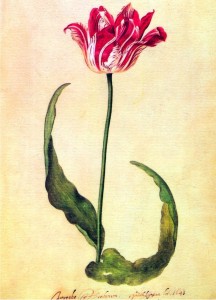
Tulip – this beautiful flower originated in Persia and Turkey and gets its name from the Turkish word for turbans. Men wore tulips on their turbans in this region, and Europeans thought the word tulip was for the name of the flower, and not the word for turban and started calling the beautiful flower tulip. It’s interesting because I also think the name looks like a turban – and some sources say that the name originated from the Turkish word for turban. Either way – it’s a perfect name for this much-loved flower.

Theofrastos Triantafyllidis (1881-1955), Still Life with gardenias and red book

Gardenia – this gorgeous white fragrant flower is named after physician and botanist Alexander Garden. It was named that not by Garden himself but Carl Linnaeus a Swedish botanist who formalized binomial nomenclature. Garden lived in Charleston, SC and had sent a magnolia to Linnaeus who felt the need to then name a flower after Garden and picked the cape jasmine and called it gardenia!!

Vincent Van Gogh, Irises, 1889

Iris – the name of this flower is from the Greek word – eiris – which is the name of the Greek Goddess of the rainbow. The flower is called that because it comes in all colors of the rainbow. It is also the flower that announces the arrival of spring by popping out of the ground sometimes through the snow.

Henri Fantin-Latour (1836-1904), Dahlias, 1874

Dahlia – these flowers symbolize summer – and are also very important for Mexico which is where they originated. They were some of the earlier flowers taken to Europe from the Americas and did well in the German and Swedish summers – and were named dahlia after a Swedish botanist Andres Dahl. The Germans wanted to name the flower Georgina after German botanist Johann Gottlieb Georgi – and called it Georgina through the 19th century until they finally gave in to the Swedes.

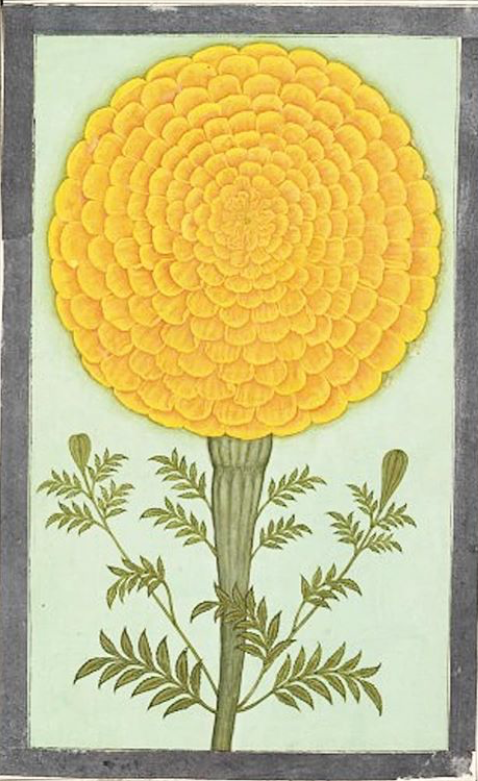
Mughal, 17th Century, unknown

Marigold – this deep yellow flower which grows profusely all year long seems to be revered in almost all religions. Its name derives from Mary’s Gold – so named after Mary, the mother of Jesus. Marigolds were taken to Europe from Mexico and Guatemala in the 16th century – in Spain they were placed at the altar of Mary which gave them their name. Marigolds are also used in all Hindu religious ceremonies.

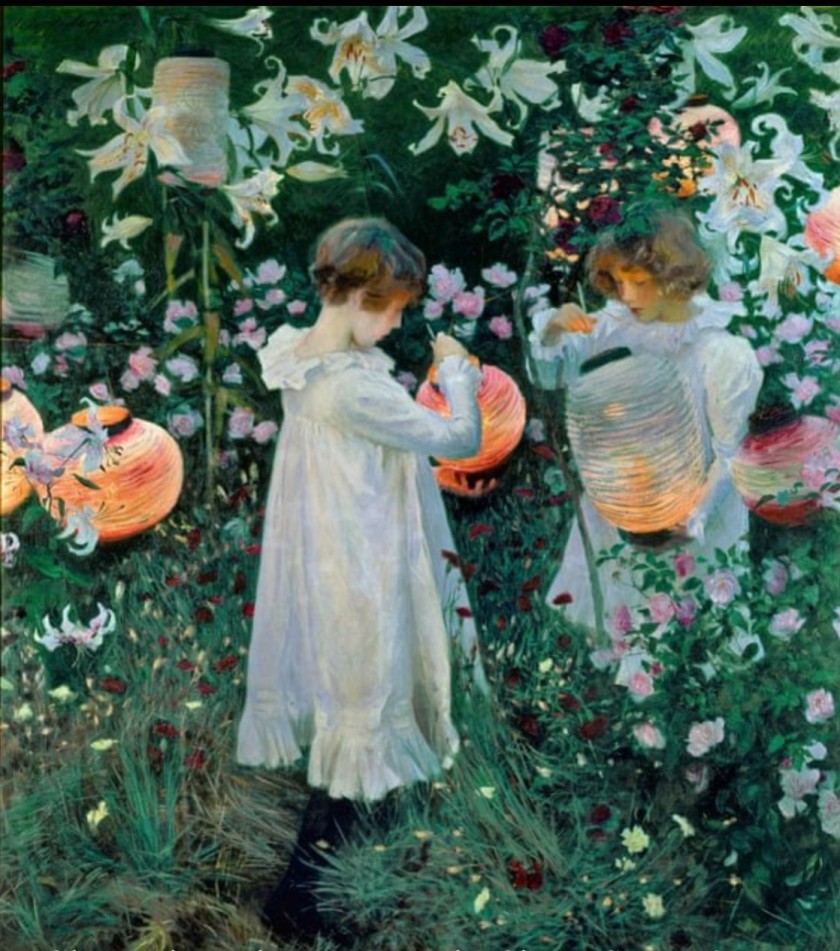
John Singer Sargent (1856-1925) Carnation Lily. Lily, Rose (1885)

Carnations – the name sounds like and is derived from the word coronation – these flowers were used in ancient Greek crowns from which they get their name. Today these flowers are used for solemn occasions.

Lily – lilies get their name from the Greek word leiron which was what they called the while lily. Lilies are the oldest cultivated flowers in the world and were grown by the Cretes as early as 1580 BCE.

So many flowers… I could go on and on !!

Braque and the Mural

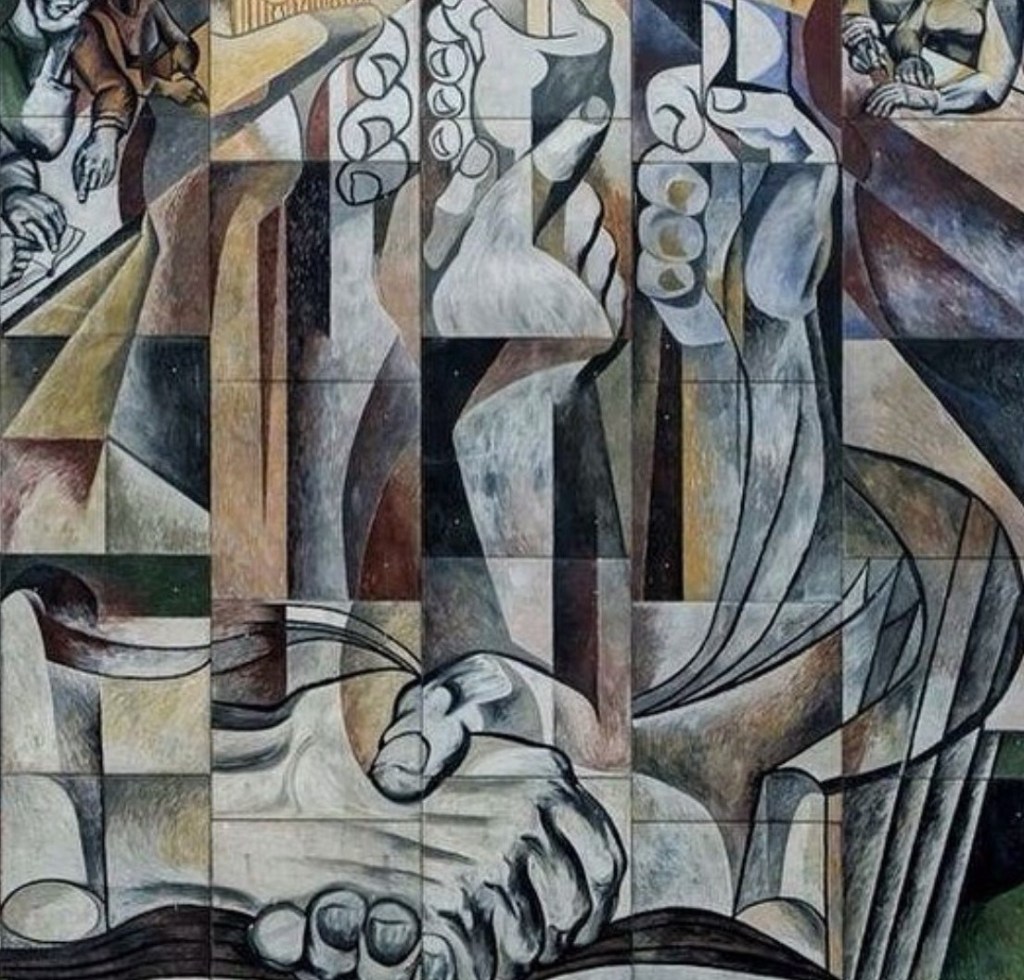
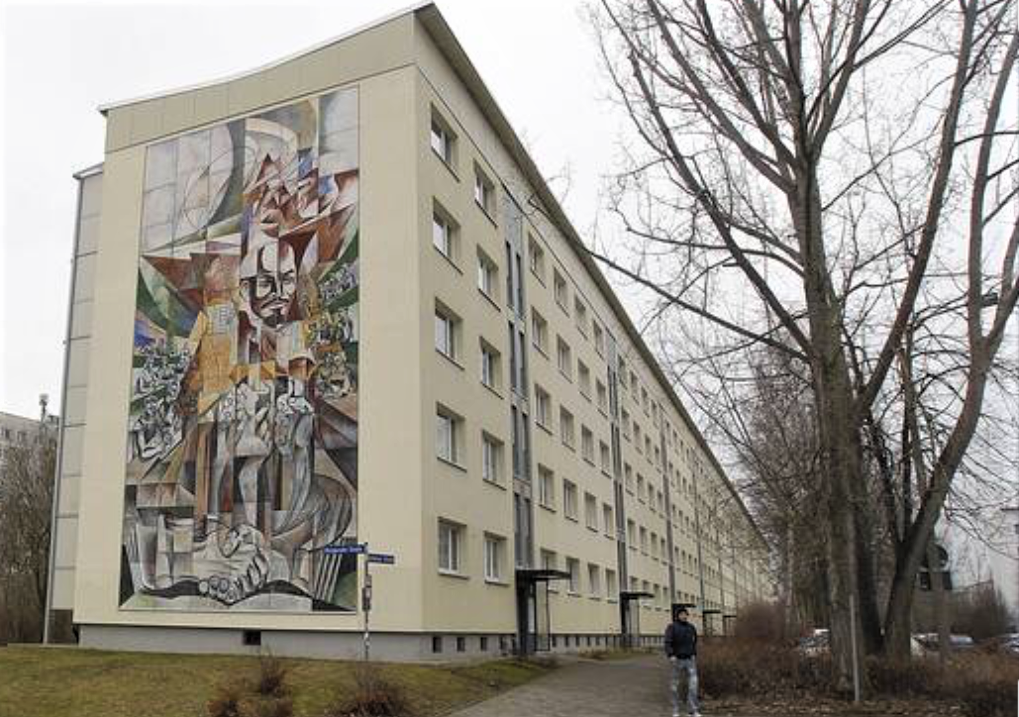
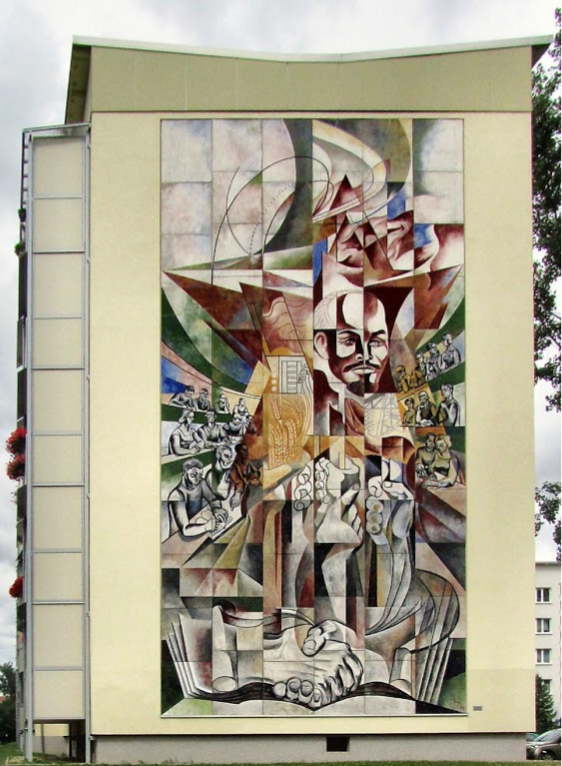
While looking at mosaics and murals from the Socialist bloc countries, I came across a cropped image of this mural on a building in Halle-Neustadt, Germany. The first thing that struck me about the mural was that it reminded me of a Georges Braque cubist artwork – it has the same monochromatic color scheme, the same geometric shapes, and abstract appearance like many of Braque’s paintings.

The mural was made by Erich Enge in 1970-71 and can be found on the side facade of a housing block building inthe ex-East German city. It is titled “Er rührte an den schlaf der welt,” which translates to “He stirred the world’s slumber.” The mural is dedicated to Lenin and the impact he had on different aspects of Socialist life are depicted in the mural.

Georges Braque, Viloin and Candlestick, 1910.

Georges Braque (1882 – 1963) was a French artist who started as a Fauvist, but was so inspired by Picasso’s foray into analytical cubism with Demoiselles D’Avignon (1907), that he collaborated with Picasso and started experimenting with cubism. One of the first works as a result of this collaboration was Violin and Candlestick (1908) in which Braque knitted together the violin, sheet music, and other elements – all pushed close to the picture plane in monochromatic colors and cubist forms.

Georges Braque, The Portugese, 1910

Like the mural there is no slow progression to the surface or depth perception – natural shapes are lost and only representational motifs remain – more so in the Braque than the mural – but the similarities are striking and exciting. Another fragmented work – The Portugese (1911), shows the fractured forms of a musician and his guitar.

The amazing large-scale mural in Halle-Neustadt with its rectangular shapes, color scheme, and fragmented parts perhaps found inspiration in Braque’s works, just like Braque found inspiration in Picasso’s work.

(Images courtesy SFMOMA, Georgesbraque.net and Erich Enge’s website).

Speedwell’s Song

Robinson Of Leyden
Oliver Wendell Holmes

HE sleeps not here; in hope and prayer 
His wandering flock had gone before, 
But he, the shepherd, might not share 
Their sorrows on the wintry shore. 

Before the Speedwell's anchor swung, 
Ere yet the Mayflower's sail was spread, 
While round his feet the Pilgrims clung, 
The pastor spake, and thus he said:-- 

'Men, brethren, sisters, children dear! 
God calls you hence from over sea; 
Ye may not build by Haerlem Meer, 
Nor yet along the Zuyder-Zee. 

'Ye go to bear the saving word 
To tribes unnamed and shores untrod; 
Heed well the lessons ye have heard 
From those old teachers taught of God. 

'Yet think not unto them was lent 
All light for all the coming days, 
And Heaven's eternal wisdom spent 
In making straight the ancient ways; 

'The living fountain overflows 
For every flock, for every lamb, 
Nor heeds, though angry creeds oppose 
With Luther's dike or Calvin's dam.' 

He spake; with lingering, long embrace, 
With tears of love and partings fond, 
They floated down the creeping Maas, 
Along the isle of Ysselmond. 

They passed the frowning towers of Briel, 
The 'Hook of Holland's' shelf of sand, 
And grated soon with lifting keel 
The sullen shores of Fatherland. 

No home for these!--too well they knew 
The mitred king behind the throne;-- 
The sails were set, the pennons flew, 
And westward ho! for worlds unknown. 

And these were they who gave us birth, 
The Pilgrims of the sunset wave, 
Who won for us this virgin earth, 
And freedom with the soil they gave. 

The pastor slumbers by the Rhine,-- 
In alien earth the exiles lie,-- 
Their nameless graves our holiest shrine, 
His words our noblest battle-cry! 

Still cry them, and the world shall hear, 
Ye dwellers by the storm-swept sea! 
Ye _have_ not built by Haerlem Meer, 
Nor on the land-locked Zuyder-Zee!

On July 23, 1620, the English Pilgrms who had been living in the Netherlands, sailed on the Speedwell. They were heading towards Sothhampton where they would meet up with the Mayflower, and togther the two ships would sail for the New World.

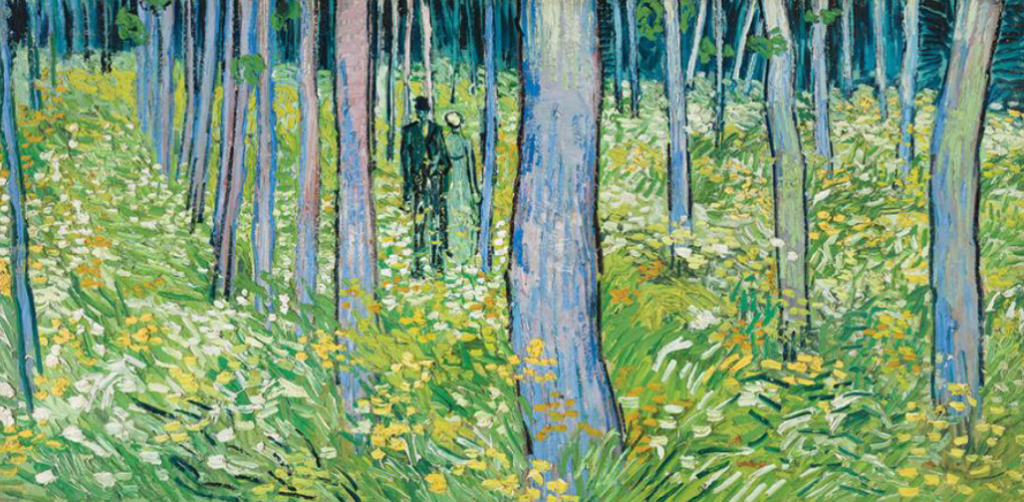
Shinrin-Yoku

“In the woods, is perpetual youth.” Ralph Waldo Emerson

Hippocrates – the father of medicine – is thought to have said, “Nature itself is the best medicine.” In his 1836 essay, Nature, Ralph Waldo Emerson said, “In the woods, we return to reason and faith. There I feel nothing can befall me in life, –no disgrace, no calamity, which nature cannot repair.”

And in the 1980s, the Japanese agreed with the truth found in these statements and their own zen philosophies and started the practice of shinrin-yoku – or forest bathing.

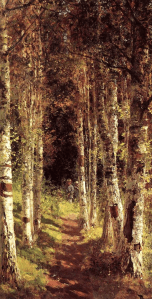
Ivan Ivanovich Shishkin (1832 – 1898) – Walk in the Woods 1869

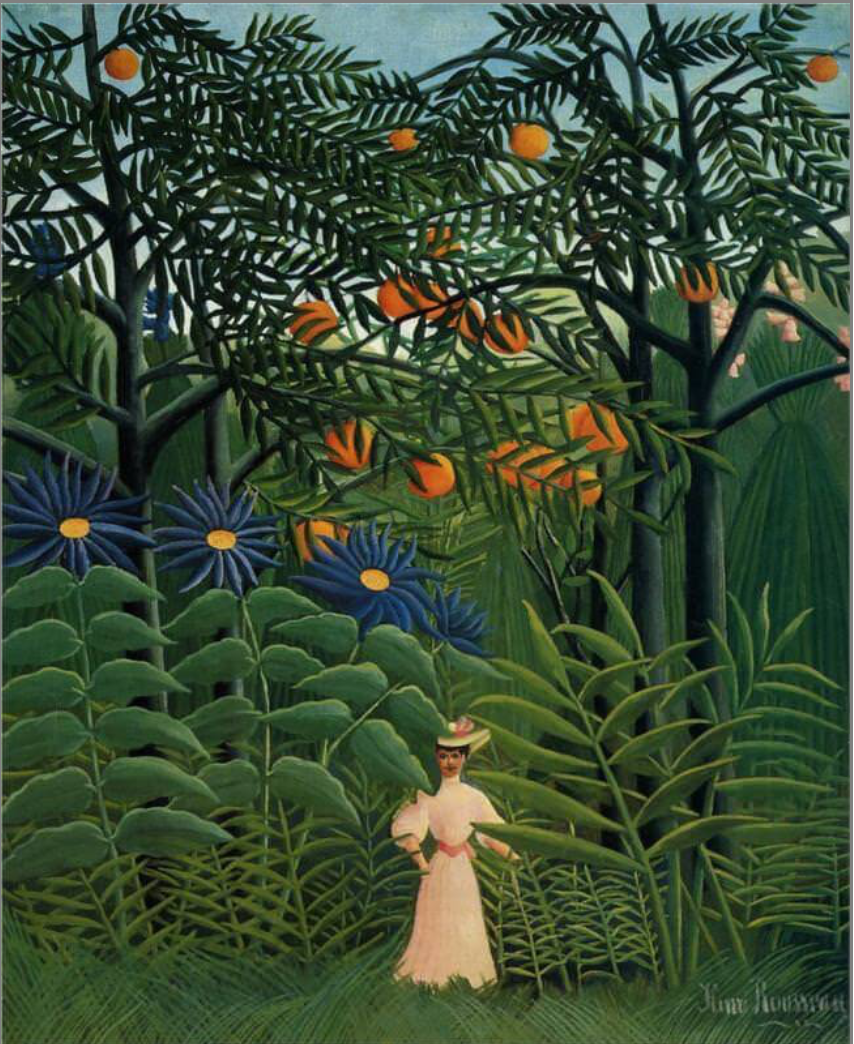
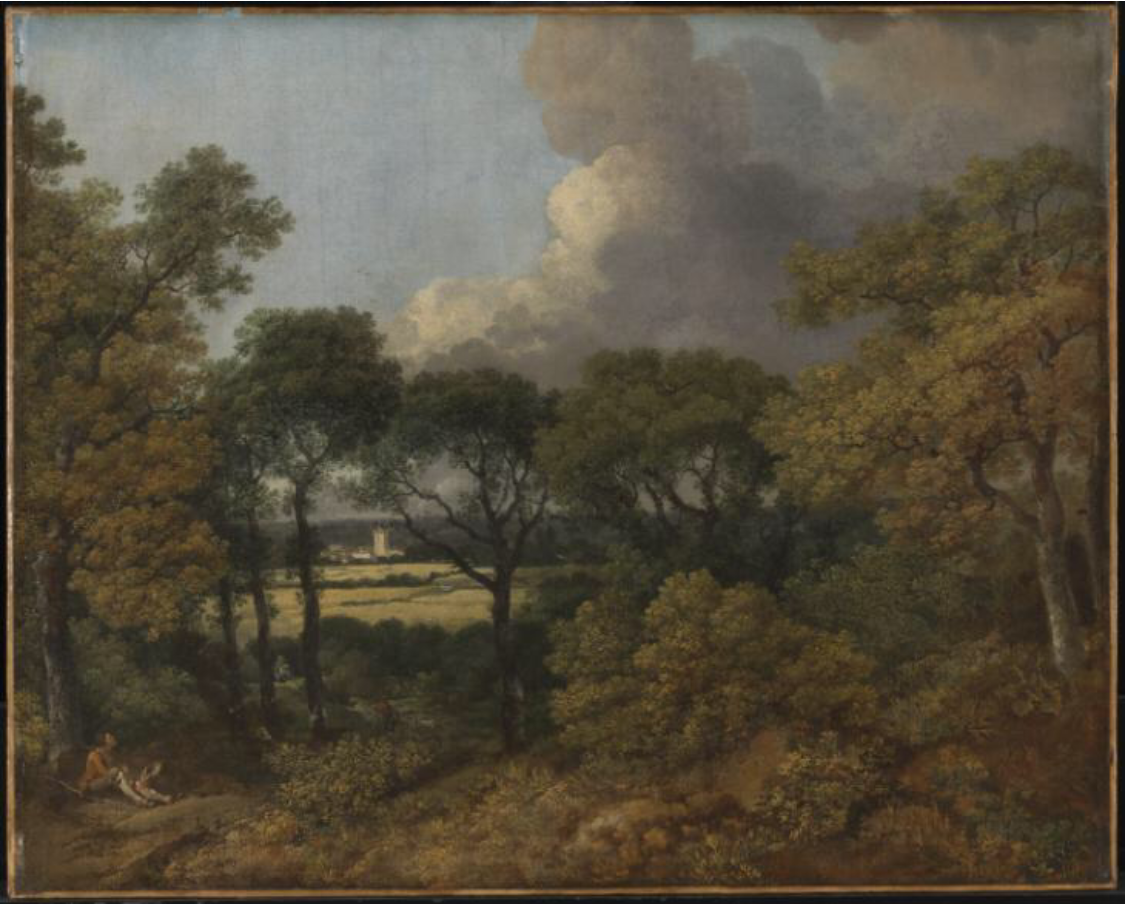
The simple act of meandering in a wooded forest, hearing the sounds it makes, or even its stillness, soaking in the sunlight as it filters through the canopy of green leaves silhouetted against the blue sky above, smelling the earthy, woody smells of the trees, and feeling the mossiness of their trunks – all of these are essential to our being. These are nature’s timeless elements that keep us grounded; and refresh our minds, bodies, and souls when we connect with them mindfully.

Shinrin-yoku started when it became apparent that technology, modernizaion, and urban landscapes themselves were causing the stress and depression found in city dwellers. But I wonder if it was just going back to our roots – to something we always did – something that we simply lost along the way and have found again.

(Images courtesy Cincinnati Museum, Rousseau.org, and Tate Gallery).

Flotsam and Jetsam

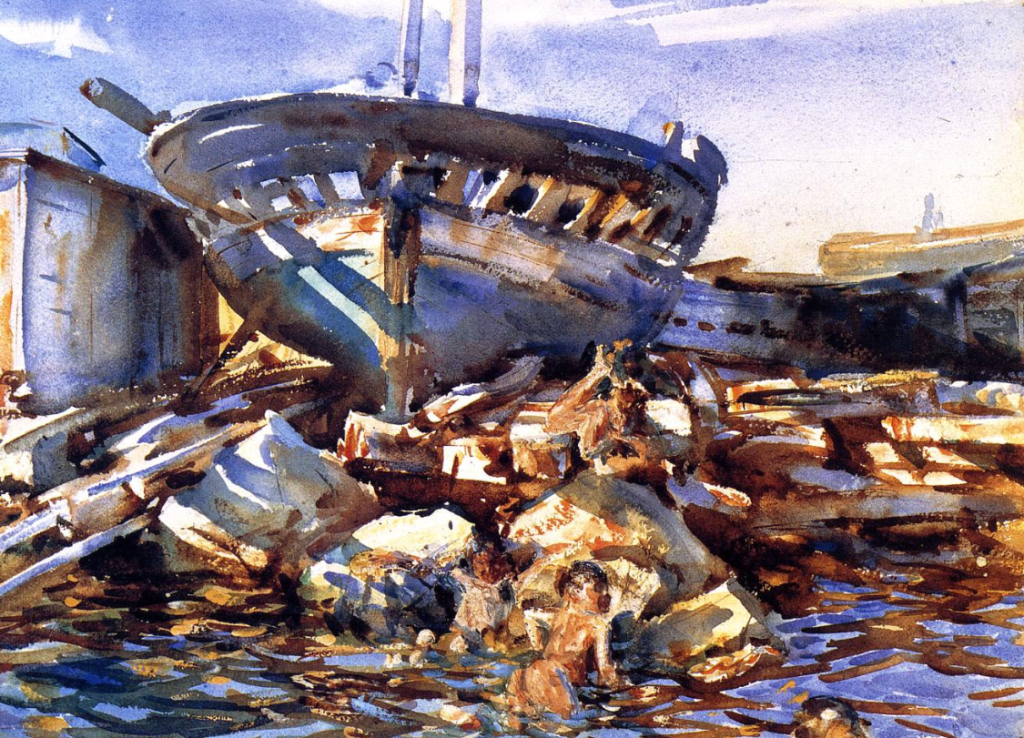
While most of us may relate to them as the twin eels in Disney’s The Little Mermaid, these two very interesting words originate from marine debris and are related to the items that were once on a ship but are now in the ocean.

Flotsam and Jetsam, 1908, John Singer Sargent, watercolor on paper

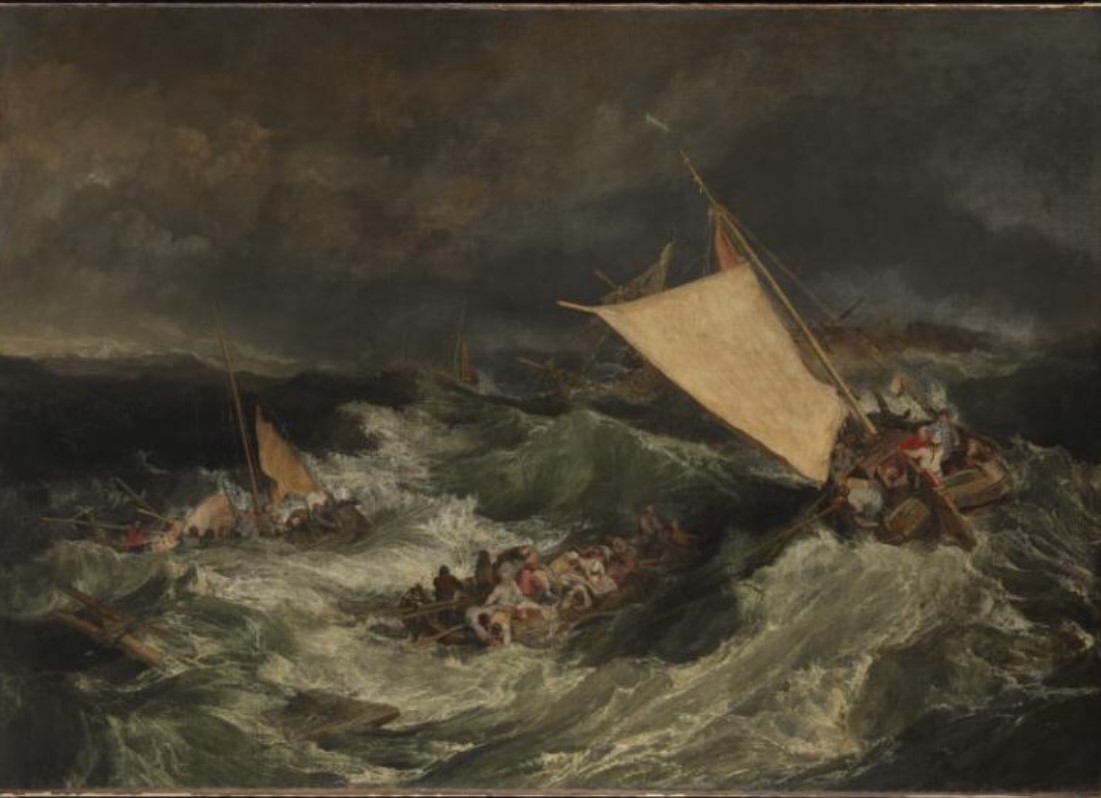
Flotsam is debris or rubbish that is found floating around in the ocean that got there because of a ship accident or wreck. It was never deliberately thrown into the ocean from the ship. The word flotsam comes from the French word floter which simply means to float. The rule of finder’s keepers does not apply to flotsam found by a passerby – the debris still belongs to the owners of the ship that met with the unfortunate accident that cause the flotsam.

Jetsam on the other hand is debris that was deliberately thrown from the ship into the ocean – either to lighten the ship before an accident or for some other reason. The important distinction is that it was deliberately thrown. The word is derived from the word jettison which means to throw something from a plane or a ship. Since they chose to throw the jetsam, the rule of finders keepers does apply in this case – and a passerby that comes across the jetsam can keep it.

The Shipwreck, 1772 Claude-Joseph Vernet, (1714-1780)

The two words are most often used together and have metaphorically come to mean odds and ends, or miscellaneous items –  as in –“the war refugees carried the flotsam and jetsam of their life on their backs as they walked across the continent searching for a safe haven.”

(Images courtesy, NGA DC, Portland Museum of Art, National Museuem of Norway, & Tate Gallery UK).